
The Hidden Law of Civil Wrongs, Damages and Compensation in Pakistan
Introduction
A statement frequently heard in Pakistani legal circles is:
“There is no law of torts in Pakistan.”
The statement is understandable—but, as a proposition of law, it is misleading.
Pakistan does not have a single, comprehensive statute called the “Torts Act” which codifies negligence, nuisance, trespass, defamation, occupiers’ liability, product liability and other civil wrongs in one place. Unlike some jurisdictions, there is no consolidated Pakistani Tort Code setting out the complete law of civil wrongs.
But the absence of a consolidated statute is not the same thing as the absence of tort law.
Pakistan inherited the common-law legal tradition. Courts have historically applied principles of English common law, equity and justice, subject to Pakistani legislation and local circumstances. Indeed, Pakistani judicial decisions have expressly recognised that the law relating to civil wrongs/torts has substantially developed through common-law principles.
At the same time, Parliament and provincial legislatures have enacted numerous statutes that create specific rights to compensation, damages and other remedies for injuries to person, property, reputation, consumer interests and other legally protected interests.
The result is a somewhat unusual legal landscape:
Pakistan does not have one unified law of torts—but it has numerous laws of civil wrongs, liability and compensation.
These laws include the law of negligence, defamation, fatal accidents, consumer protection, motor-vehicle liability, product liability, contractual compensation, constitutional compensation, medical negligence and the Islamic concepts of Qisas, Diyat, Arsh and Daman.
The more accurate question, therefore, is not:
“Does Pakistan have tort law?”
but:
“Why has Pakistan never consolidated its scattered law of civil wrongs into a coherent modern law of torts?”
1. Tort Law and the Pakistani Legal System
A tort is broadly understood as a civil wrong—other than breach of contract—for which the law provides a remedy.
Typical examples include:
- negligence;
- nuisance;
- trespass;
- defamation;
- assault and battery;
- false imprisonment;
- interference with property rights;
- wrongful death;
- professional negligence;
- product liability; and
- other wrongful conduct causing legally recognised injury.
The classic remedy is damages, although modern tort law also recognises injunctions, declarations, restitution and other forms of relief.
Pakistan’s position is different from the misconception that “nothing exists because there is no Torts Act.”
The legal principles have developed through:
- inherited common-law principles;
- judicial precedent;
- statutes dealing with specific wrongs;
- the Contract Act and other civil statutes;
- consumer-protection legislation;
- the Pakistan Penal Code and Qisas and Diyat framework;
- constitutional jurisprudence; and
- specialised regulatory regimes.
The law is therefore fragmented rather than absent.
2. The Common-Law Foundation of Tortious Liability
The common-law heritage remains important.
Pakistani courts have historically administered principles of justice, equity and good conscience where legislation does not provide a complete answer.
This means that a person who suffers a legally recognised injury may, depending upon the circumstances, seek a civil remedy even though the relevant cause of action is not contained in a statute bearing the word “tort”.
The practical consequence is significant.
For example, a claim arising from:
- negligent conduct,
- interference with property,
- nuisance,
- wrongful detention,
- damage to reputation,
may involve principles developed through judicial precedent rather than a single codified Tort Act.
Therefore:
No Tort Act ≠ No Tort Law.
3. Negligence: Perhaps the Most Important “Invisible” Tort
Negligence is one of the clearest examples of how the misconception arises.
Pakistan has no comprehensive Negligence Act.
Yet claims based upon negligent conduct arise in numerous contexts.
The basic elements generally revolve around:
Duty of care
Did the defendant owe a legally recognised duty to the claimant?
Breach
Did the defendant fail to exercise the standard of care required in the circumstances?
Causation
Did the breach cause the injury or loss?
Damage
Did the claimant suffer a legally compensable injury or loss?
These principles may arise in:
- road accidents;
- medical negligence;
- construction accidents;
- workplace accidents;
- defective products;
- professional services;
- unsafe premises;
- transportation;
- commercial services; and
- public-authority negligence.
Thus, a Pakistani claimant may have a perfectly recognisable negligence claim without ever filing something called a “tort suit”.
4. Fatal Accidents Act, 1855: One of Pakistan’s Oldest Statutory Compensation Laws
One of the strongest answers to the proposition that Pakistan has “no tort law” is the Fatal Accidents Act, 1855.
The Act continues to appear in Pakistan’s federal legislation as a civil law statute.
Its purpose is essentially to provide a civil remedy where a person’s death is caused by a wrongful act, neglect or default.
The importance of the statute is obvious.
A wrongful death can produce:
- loss of dependency;
- financial loss;
- loss arising from the deceased’s contribution to the family;
- funeral-related consequences; and
- other legally recognised losses.
Pakistani judicial material has also recognised the application of the Fatal Accidents Act in cases involving medical negligence and fatal accidents.
This is quintessential compensation law.
5. Diyat, Arsh and Daman: An Islamic Dimension of Compensation
The most intellectually interesting part of Pakistan’s legal system is perhaps the relationship between tortious compensation and the Islamic concepts introduced into the Pakistan Penal Code.
The Qisas and Diyat provisions of the PPC provide a statutory framework dealing with offences against the human body and life.
Among the concepts are:
- Qisas
- Diyat
- Arsh
- Daman
The Pakistan Penal Code expressly contains provisions dealing with the value of Daman and the disbursement of Arsh or Daman.
Diyat
Diyat is a prescribed monetary compensation associated with the death of a human being in circumstances covered by the Qisas and Diyat framework.
Arsh
Arsh is compensation prescribed for specified injuries.
Daman
Daman is compensation which may be determined by the Court in cases falling within the statutory framework.
Section 337-Y of the PPC is particularly significant. In determining Daman, the law takes into account matters such as treatment expenses, loss or disability in the functioning of an organ and the anguish suffered by the victim.
This is important because compensation is not merely about punishment.
It recognises the injury suffered by the victim.
That does not mean that Diyat, Arsh and Daman are technically identical to common-law damages.
They are not.
They arise within a distinct Islamic/criminal-law statutory framework and must be understood according to their own legal concepts.
But from the perspective of legal philosophy, they demonstrate that Pakistani law recognises a powerful principle:
A person who causes legally recognised harm may have an obligation to compensate the victim.
Accordingly, it is more accurate to describe Arsh and Daman as Islamic statutory forms of compensation which overlap, in certain respects, with the compensatory objectives of tort law, rather than simply calling them “Islamic tort law”.
6. Criminal Proceedings Can Also Produce Compensation
The distinction between criminal and civil law is not always absolute when it comes to compensation.
Section 544-A of the Code of Criminal Procedure, 1898 provides a particularly important example.
Where a person is convicted of an offence in the commission of which death, hurt, injury or damage to property has been caused, the Court may order compensation to the relevant victim, heirs or property owner, subject to the statutory framework.
This means that compensation may sometimes arise within criminal proceedings themselves, in addition to the criminal sentence.
Similarly, section 250 CrPC permits compensation in certain cases involving false, frivolous or vexatious accusations.
This demonstrates another important feature of Pakistani law:
A wrong may generate more than one form of legal consequence.
The same factual event can potentially produce:
- criminal liability;
- statutory compensation;
- a civil claim for damages; and/or
- constitutional relief,
depending upon the circumstances.
7. Defamation: A Classic Tort With Statutory Remedies
Defamation is perhaps the most obvious example of a tortious wrong that has been given statutory form.
The Defamation Ordinance, 2002 expressly treats defamation as an actionable wrong.
The Ordinance recognises:
- slander;
- libel;
- presumptive damage;
- general damages;
- special damages;
- apology; and
- other remedies.
Under section 9, where defamation is proved, the court may order an apology and publication of the apology and award compensatory damages, together with proved special damage.
The Ordinance also provides a notice requirement before an action can be instituted.
Therefore, defamation alone demonstrates why the proposition “Pakistan has no tort law” is problematic.
8. * Punjab Defamation Act, 2024: A New Dimension
Punjab has subsequently enacted the Punjab Defamation Act, 2024, creating a separate statutory framework for defamation in the province.
The Act expressly characterises defamation as a civil wrong and provides that a claimant may proceed without proving actual monetary loss; where defamation is established, general damages are presumed.
The statute also recognises:
- general damages;
- special damages;
- punitive damages;
- apology;
- publication of apology; and
- remedies relating to defamatory online material.
The Act defines general damages with a minimum statutory figure of Rs. 3 million in the circumstances specified by the Act, while punitive damages may extend to multiple times the general damages where the statutory conditions are met.
This is particularly significant in the age of:
- Facebook;
- X;
- Instagram;
- TikTok;
- YouTube;
- WhatsApp; and
- other digital platforms.
However, the legal position should be stated carefully. The Punjab Defamation Act has been challenged before the Lahore High Court, including questions concerning legislative competence, tribunal structure and the statutory damages regime. As of 2026, the constitutional litigation remains an important part of the legal context.
Accordingly, lawyers and litigants should verify the latest judicial orders before relying upon any provision procedurally.
9. Consumer Protection: Tort Principles Hidden Inside Consumer Law
Consumer-protection legislation provides perhaps the clearest modern example of statutory tort principles.
Punjab’s Consumer Protection Act, 2005, for example, deals with:
- defective products;
- defective design;
- defective construction;
- inadequate warnings;
- breach of express warranties;
- faulty services;
- negligence;
- misleading practices; and
- consumer compensation.
Section 25 specifically provides for claims for damages arising from contravention of the Act.
Section 31 provides a remarkably broad range of remedies, including:
- removal of defects;
- replacement;
- refund;
- reasonable compensation;
- damages;
- actual litigation costs and lawyers’ fees;
- recall or destruction of defective products;
- rectification of defects; and
- cessation of faulty services.
The Lahore High Court has also recognised that consumer courts can award general damages and compensation in appropriate cases, including cases involving negligent services.
This is essentially statutory civil-wrong law operating in a specialised consumer environment.
10. Punjab Consumer Protection Law After the 2025 Amendment
The subject has become even more relevant in Punjab following the Punjab Consumer Protection (Amendment) Act, 2025.
Among other changes, the amendment expanded the statutory definition of consumer transactions to include offline and online transactions through electronic means, teleshopping, direct selling and multi-level marketing.
This is significant because consumer disputes are no longer confined to the traditional:
“shop → customer → receipt”
model.
Modern consumer claims can arise from:
Instagram seller → online payment → courier → defective product → economic loss
or:
website → digital payment → defective service → financial and non-financial loss.
Punjab’s 2025 reforms also changed the institutional structure of consumer adjudication, with District and Additional District Judges being designated to hear consumer cases following the abolition/restructuring of the former dedicated consumer courts.
Thus, consumer law is now an increasingly important route for compensation arising from defective products and faulty services.
11. Consumer Protection Beyond Punjab
Consumer protection is not confined to Punjab.
Different provinces have enacted their own consumer-protection frameworks.
For example:
Sindh
The Sindh Consumer Protection Act, 2014 contains a product-liability regime and expressly addresses liability for damage caused by defective products. It also restricts contractual attempts to exclude or limit certain statutory liability.
Balochistan
The Balochistan Consumers Protection Act, 2003 provides for compensation where unfair trade practices cause consumer loss or damage.
The exact jurisdiction, procedure, limitation period and available remedies therefore depend upon the province and the particular transaction.
12. Motor-Vehicle Accidents
Road accidents are another major area in which compensation operates without requiring a claimant to invoke some abstract “Torts Act”.
The Provincial Motor Vehicles Ordinance, 1965 contains provisions relating to compensation claims arising from death or injury in specified circumstances.
The legislation provides for claims before a Claims Tribunal and specifies who may institute such claims, including injured persons and, in cases of death, legal representatives.
A typical accident may therefore involve:
- criminal proceedings against the driver;
- compensation proceedings;
- a civil negligence claim;
- insurance-related proceedings;
- statutory motor-vehicle remedies; and
- in appropriate cases, other regulatory proceedings.
Again, the law is fragmented—but the right to seek compensation is very real.
13. Medical Negligence
Medical negligence is another area frequently described as “tort law” in other common-law jurisdictions.
In Pakistan, however, the legal route may involve several overlapping regimes.
Depending upon the facts, a patient may have potential remedies arising from:
- negligence principles;
- consumer-protection legislation;
- professional regulatory law;
- contractual obligations;
- criminal law;
- constitutional jurisdiction in appropriate cases; and
- statutory compensation mechanisms.
The Fatal Accidents Act has historically been invoked in fatal medical-negligence situations, and Pakistani judicial materials recognise the relevance of medical negligence within the Act’s framework.
The important point is that the legal character of a medical-negligence claim depends upon the cause of action and the relief sought.
It should not automatically be assumed that every medical grievance is either a tort claim or a criminal offence.
14. Contractual Damages Are Different—but Closely Related
A major category of monetary compensation in Pakistan comes from the Contract Act, 1872.
Section 73 provides compensation for loss or damage caused by breach of contract, while section 74 deals with compensation where a sum is named in the contract or there is a stipulation by way of penalty.
This is technically not tort law because contractual liability arises from a consensual legal relationship.
Nevertheless, it is part of the broader Pakistani law of civil compensation.
The distinction can be illustrated simply:
Tort
“You injured me even though we had no contract.”
Contract
“You failed to perform the obligation you agreed to perform.”
Both can result in monetary compensation—but the legal basis is different.
15. Sale of Goods and Breach of Warranty
The Sale of Goods Act, 1930 provides another statutory source of monetary remedies. The Act is part of Pakistan’s civil-law framework.
Depending upon the circumstances, a buyer may have remedies arising from:
- breach of condition;
- breach of warranty;
- non-conforming goods;
- defective goods;
- non-delivery;
- repudiation; and
- related losses.
Again, the remedy may look like a “damages claim”, but the legal source may be contract and sale-of-goods law rather than tort.
This distinction matters because different rules concerning:
- causation;
- remoteness;
- proof;
- limitation;
- contractual terms; and
- measure of damages
may apply.
16. Specific Relief Act, 1877
The Specific Relief Act, 1877 is another important component of Pakistan’s civil-remedies framework.
Section 19 expressly permits compensation to be claimed along with specific performance—or in substitution for specific performance in appropriate circumstances.
This demonstrates that Pakistani civil litigation does not always force a claimant to choose between:
“performance” OR “money.”
Depending upon the circumstances, the court may provide:
- specific performance;
- compensation;
- injunction;
- or combinations of appropriate relief.
17. Constitutional Compensation: A Form of Public-Law Remedy
One of the most fascinating developments in Pakistani jurisprudence is the availability of monetary compensation in appropriate constitutional cases.
Article 199 gives the High Courts jurisdiction to enforce fundamental rights and issue appropriate directions where the constitutional requirements are satisfied.
Pakistani judicial decisions have recognised circumstances in which monetary compensation may be awarded for violation of fundamental rights. Importantly, this is conceptually distinct from a conventional private tort action.
The Islamabad High Court has described such compensation as a public-law duty, distinct from the private-law right to claim damages in tort.
This distinction is crucial.
A constitutional court may, in an appropriate case, provide monetary relief to vindicate a fundamental right even though the proceedings are not an ordinary civil suit for damages.
Recent Pakistani constitutional jurisprudence has also discussed vindicatory damages as a public-law remedy for serious violations of constitutional rights, particularly where ordinary remedies are inadequate.
Therefore, Pakistani law has developed beyond the traditional private-law conception of damages.
18. False Imprisonment and Unlawful Detention
Wrongful deprivation of liberty provides another important example.
Depending upon the circumstances, a person subjected to unlawful detention may have remedies through:
- constitutional jurisdiction;
- habeas corpus;
- criminal law;
- civil proceedings;
- public-law compensation; and
- disciplinary or departmental mechanisms.
The constitutional dimension is especially important because the Constitution protects life, liberty, dignity, reputation and property from unlawful state action.
In appropriate cases, compensation may therefore become part of the constitutional remedy rather than merely an ordinary tort claim.
19. Nuisance and Interference With Property Rights
Private and public nuisance remain relevant examples of common-law civil wrongs.
Potential disputes include:
- excessive noise;
- smoke;
- dangerous emissions;
- obstruction;
- unlawful interference with use of property;
- environmental interference;
- water-related interference; and
- activities substantially affecting neighbouring property.
Depending upon the facts, remedies can include:
- injunction;
- declaration;
- damages;
- mandatory directions; and
- regulatory enforcement.
This is another area where the absence of a single “Nuisance Act” does not mean that the underlying legal concept disappears.
20. Trespass
Trespass to land and certain forms of trespass to the person remain part of the broader common-law heritage.
A person whose property rights are unlawfully interfered with may potentially seek:
- possession;
- injunction;
- declaration;
- damages;
- mesne profits;
- compensation for loss of use; and
- other consequential relief.
The precise cause of action and remedy will depend upon the factual and statutory framework.
21. Interest as a Component of Monetary Relief
The law of compensation is not necessarily limited to the principal amount.
Interest may become relevant in appropriate proceedings.
Pakistan has an **Interest Act, 1839, and interest can also arise under contractual, statutory and procedural principles depending upon the nature of the claim.
The availability and rate of interest will depend upon:
- the cause of action;
- the statute involved;
- the contractual terms;
- the court’s jurisdiction; and
- the applicable procedural law.
Thus, a successful claimant’s ultimate monetary recovery can potentially include more than the underlying principal loss.
22. Costs of Litigation
Another frequently overlooked form of monetary relief is litigation cost.
In appropriate cases, the court may award:
- court costs;
- actual costs;
- lawyer’s fees where authorised by the applicable statute;
- expenses caused by unnecessary litigation; and
- other procedural costs.
Consumer legislation is particularly explicit in this regard. Punjab’s Consumer Protection Act permits the Consumer Court to award actual costs, including lawyers’ fees, in appropriate cases.
Costs are not technically the same thing as tort damages, but they form part of the broader remedial architecture of civil justice.
23. A Practical Map of Compensation Remedies in Pakistan
A useful way to understand the Pakistani system is to stop asking:
“Is there a Tort Act?”
and instead ask:
“What legally protected interest has been injured, and what statute or legal principle provides the remedy?”
| Wrong / Injury | Possible Legal Source | Possible Remedy |
|---|---|---|
| Negligence | Common law / judicial precedent | Damages |
| Wrongful death | Fatal Accidents Act, 1855 | Compensation |
| Bodily injury | PPC / Qisas & Diyat / civil law | Arsh, Daman, damages |
| Death in criminal offence | CrPC s.544-A / PPC | Compensation |
| Defamation | Defamation Ordinance 2002 / Punjab Defamation Act 2024 | General & special damages, apology |
| Defective product | Consumer protection legislation | Replacement, refund, compensation, damages |
| Faulty service | Consumer protection legislation | Compensation, damages, costs |
| Road accident | Motor-vehicle legislation / negligence law | Compensation/damages |
| Medical negligence | Civil law / consumer / regulatory law | Compensation/damages |
| Breach of contract | Contract Act, 1872 | Compensation/damages |
| Breach of warranty | Sale of Goods Act, 1930 | Damages/other contractual remedies |
| Failure to perform sale contract | Specific Relief Act / contract law | Specific performance + compensation |
| Property interference | Common law / civil law | Injunction/damages/mesne profits |
| Nuisance | Common law / statutory law | Injunction/damages |
| Unlawful detention | Constitution / public law / civil law | Compensation and other relief |
| Fundamental-right violation | Constitution | Constitutional/public-law compensation |
| False/frivolous accusation | CrPC s.250 | Compensation |
| Damage to property caused by crime | CrPC s.544-A | Compensation |
| Consumer fraud/misrepresentation | Consumer laws | Refund, compensation, damages, penalties |
| Professional negligence | Common law/statutory/regulatory law | Compensation/damages |
| Financial/service-sector misconduct | Special regulatory statutes | Compensation/restoration/other statutory relief |
This table should not be read as saying that every remedy is available in every case. The cause of action, jurisdiction, limitation, evidence, statutory prerequisites and available forum must always be examined separately.
24. The Real Problem: Fragmentation
The real weakness of Pakistani tort law is therefore not necessarily absence.
It is fragmentation.
A claimant may have to determine whether the case falls under:
- common-law negligence;
- the Fatal Accidents Act;
- the Contract Act;
- the Sale of Goods Act;
- consumer legislation;
- the Motor Vehicles Ordinance;
- the PPC;
- Qisas and Diyat provisions;
- the CrPC;
- the Constitution;
- a professional regulatory statute;
- a provincial statute; or
- some combination of these.
This creates uncertainty.
Two similar injuries may potentially travel through completely different legal routes.
That can affect:
- limitation;
- jurisdiction;
- burden of proof;
- quantum of damages;
- procedural requirements;
- court fees;
- availability of injunction;
- availability of general damages;
- availability of special damages;
- appellate remedies; and
- enforcement.
25. Why Pakistan May Need a Modern Law of Torts
A modern Pakistani law of torts could potentially consolidate principles concerning:
Negligence
Including duty of care, breach, causation and remoteness.
Professional liability
Including medical, legal, engineering and other professional negligence.
Product liability
Including defective products and failure to warn.
Premises liability
Including duties of occupiers and owners.
Environmental harm
Including pollution and damage to natural resources.
Privacy
Including unlawful interference with personal information and dignity.
Digital wrongs
Including online harassment, privacy violations and certain forms of digital misconduct.
Public-authority liability
Including circumstances in which governmental negligence or unlawful conduct causes compensable harm.
Damages
A modern statute could provide clearer rules regarding:
- general damages;
- special damages;
- aggravated damages;
- exemplary/punitive damages;
- nominal damages;
- future loss;
- loss of earning capacity;
- medical expenses;
- rehabilitation;
- pain and suffering;
- mental anguish;
- loss of consortium where legally recognised;
- interest; and
- mitigation.
Such legislation could make the law more accessible to ordinary citizens.
26. But Would Codification Really Solve Everything?
Not necessarily.
Tort law is highly fact-sensitive.
No statute can completely eliminate judicial development.
Even countries with comprehensive tort legislation continue to rely heavily upon judicial interpretation.
The better objective may therefore be:
Codification without destroying judicial development.
A Pakistani Tort Law could establish the basic framework while allowing courts to develop the law in response to:
- technology;
- medical science;
- environmental risks;
- artificial intelligence;
- digital platforms;
- autonomous vehicles;
- data breaches;
- commercial practices; and
- emerging forms of injury.
27. The Islamic and Common-Law Traditions Need Not Be Seen as Opposites
Pakistan’s legal system contains an unusual combination of:
Common law + statutory law + Islamic legal principles + constitutional law.
The concepts of Diyat, Arsh and Daman demonstrate that compensation for injury has an important Islamic legal dimension.
The common-law principles of negligence, nuisance and trespass demonstrate another legal tradition.
Constitutional compensation demonstrates a third.
Consumer law demonstrates a fourth.
These need not necessarily be viewed as mutually exclusive.
The underlying policy question is often the same:
When one person causes legally recognised harm to another, what remedy should the legal system provide?
The legal route may differ, but the remedial objective may overlap.
28. A Better Way to Describe Pakistani Tort Law
It would therefore be inaccurate to say:
“There is no tort law in Pakistan.”
It would be more accurate to say:
“Pakistan has no single comprehensive codification of tort law, but it possesses a substantial and developing body of law governing civil wrongs, negligence, reputation, personal injury, property interference and compensation through common-law principles, statutes, Islamic legal provisions and constitutional jurisprudence.”
That distinction may appear semantic.
It is not.
It fundamentally changes the way lawyers approach claims for compensation.
Conclusion
The proposition that “tort law does not apply in Pakistan” is perhaps one of the most persistent oversimplifications in Pakistani legal discourse.
Pakistan certainly lacks a modern, unified Tort Act.
But Pakistan does not lack remedies for civil wrongs.
The law provides compensation through a surprisingly wide network of legal sources:
Common-law negligence.
Fatal Accidents Act, 1855.
Defamation legislation.
Consumer-protection laws.
Motor-vehicle laws.
Contract Act, 1872.
Sale of Goods Act, 1930.
Specific Relief Act, 1877.
Pakistan Penal Code.
Qisas, Diyat, Arsh and Daman.
Code of Criminal Procedure.
Constitutional/public-law remedies.
Professional and regulatory legislation.
And numerous sector-specific statutes.
The real deficiency is not the complete absence of compensation law.
It is that the law exists in pieces.
Perhaps, therefore, the most important question for Pakistani legal scholarship is not:
“Does Pakistan have a law of torts?”
but:
“Should Pakistan consolidate its fragmented law of civil wrongs into a modern, coherent and accessible Law of Torts?”
That is a debate worth having.
And perhaps it is time for Pakistan’s lawyers, judges, academics and legislators to have it.
Legal Note
This article is intended for general legal information, academic discussion and public legal awareness. Pakistani statutes, provincial laws, judicial interpretations, procedural requirements and the availability of particular remedies may change over time. The availability of a specific remedy depends upon the facts of the case, the applicable legislation, limitation, jurisdiction, evidence and the forum before which the claim is brought.
*The legal position concerning the Punjab Defamation Act, 2024 is subject to constitutional litigation and judicial orders. Its provisions, particularly those concerning jurisdiction, procedure, tribunals and damages, should therefore be checked against the latest position of the Lahore High Court and any subsequent appellate or constitutional proceedings before being relied upon in practice.
**Similarly, the Interest Act, 1839 is included in this discussion as part of Pakistan’s historical civil-law framework concerning interest and monetary relief. However, the Pakistan Code currently lists the Interest Act, 1839 as a Civil Law and marks it “Under Review.” Accordingly, its current legal status, applicability and interaction with other provisions governing interest—including section 34 of the Code of Civil Procedure, 1908 and other applicable statutory or contractual provisions—should be verified against the latest legislation, Gazette notifications and judicial decisions before relying upon it in a particular case.
This article does not constitute legal advice in relation to any particular dispute. Readers facing an actual claim or potential liability should obtain case-specific advice from a qualified advocate after examination of the relevant facts and documents.
Ahsan Legal Services (ALS)
All Legal Services Under One Roof

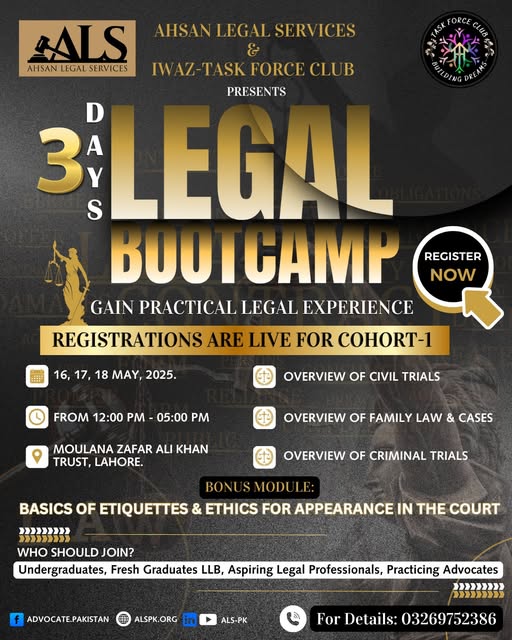
 16, 17, 18 May 2025
 12:00 PM – 05:00 PM Daily
 Day 1: Family Law Practice
 Register now through the link provided:
  Limited seats — Priority for early registrants.
