
(Compiled by our fellows namely: Samia Tehreem and Ali Zaib, students of Faculty of Law, University of Central Punjab, Lahore.)
The Act imposes punishment i.e., imprisonment, and fine,on the person who illegally dispossesses a person from his immovable property. The offender may also be arrested after obtaining an arrest warrant. In addition to this, the victim is also entitled to compensation under the Act.
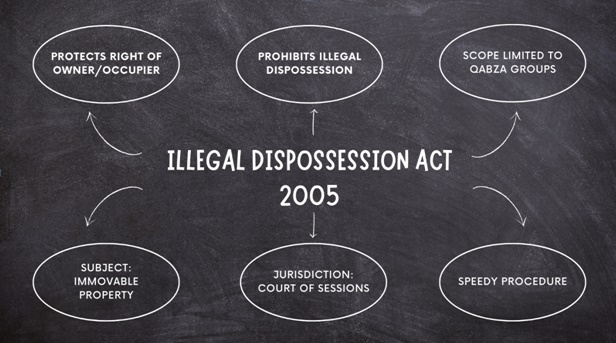
The Illegal Dispossession Act, 2005 (the “Act”), protects the right of possession of lawful occupiers and owners of immovable property by preventing its illegal dispossession by property grabbers and Qabza groups. An occupier is the person who has possession of the immovable property, whereas an owner is the person who owns the immovable property, as defined by the Act. The Court of Sessions has got the exclusive jurisdiction pertaining to cases under the Act.
The speedy and simple procedure for disposal of the case has been provided in the Act. Proceedings are initiated by filing a complaint before the Court of Sessions. Upon instructions, the SHO, after investigation, submits the report thereof. Besides, the Court may also require a report after local inquiry from a Magistrate or a Revenue officer. Under the Act, the case must be concluded within 60 days without unnecessary adjournments, however, in the interest of justice an adjournment for not more than seven days may be granted. Further, in case of dismissal of complaint being false or frivolous, the complainant may also be burdened with compensatory cost up to five lac rupees.
The Court may evict the illegal possessor and restorethe possession of occupier/owner during the pendency of the case on temporary basis.The Court may implement its orders through officials/officers and even through police force. If the Court concludes that an offence has been committed, the final order may also be implemented in the same manner. An appeal lies against orders within 30 days in the Honorable High Court.
The question now is why such legislation was needed when laws on the same subject already exist. A person who has been illegally evicted from his land may also initiate a claim under Section 9 of the Specific Relief Act of 1877. The leading judgement of the Full Bench of the High Court, titled Zahoor Ahmad vs Stated, reported as PLD 2007 LHR 231, demonstrates the significance of this Act, in which the Lahore High Court has drawn the yardstick vis-à-vis application of the Act.
According to this judgment, the complaint under this Act can only be filed against persons involved in previous activity connected with illegal dispossession or some persons who made organized or calculated effort individually or in groups to illegally dispossess someone of their property. It cannot be filed against ordinary persons who are not property grabbers or when the matter of possession of the relevant property is being regulated by a civil or revenue court.
The same principle was upheld by Supreme Court in a case titled Bashir Ahmad vs Additional Sessions Judge, Faisalabad, reported as PLD 2010 SC 661, where it was stated that when no material is available as to show that accused person belongs to a Qabza group, the complainant cannot attempt to transfer a civil dispute into a criminal case as same will amount to the abuse of the process of law.
The term “property grabbers” is used in the Act’s Preamble but is not defined anywhere in the Act. Members of the National Assembly and Senate unanimously agreed that this term is synonymous with Qabza Mafia. As a result, any other application of the Act would be contrary to its spirit. The scope of the Act is limited to cases related to Qabza Mafia.