
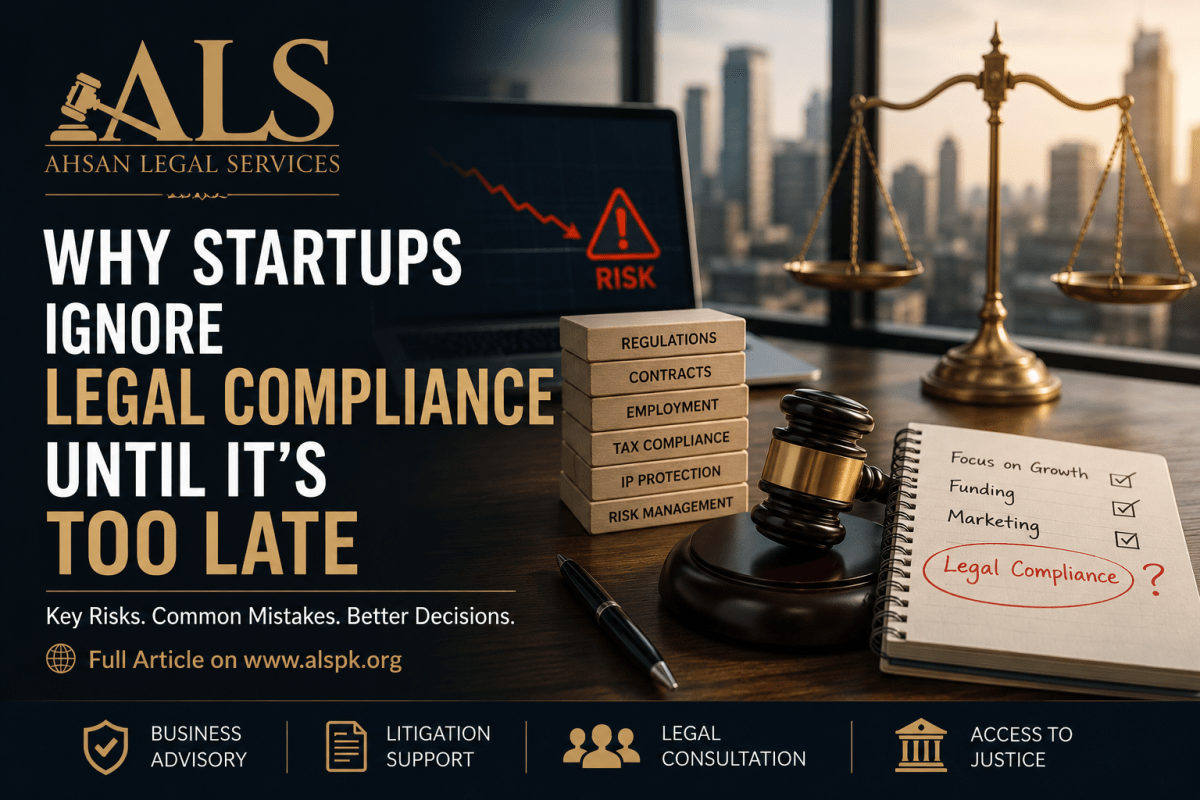
One of the most common patterns I have observed while advising businesses and startups is that most founders focus intensely on growth, branding, marketing, funding, and operations — but legal compliance is often treated as an afterthought. I have personally seen businesses collapse not because the idea was weak, but because the founders ignored basic documentation and compliance in the early stages. In many cases, founders approached us only after relationships between partners have already deteriorated.
Unfortunately, by the time legal issues surface, the cost of correction becomes far greater than the cost of prevention.
Why does this happen?
- Startups prioritize survival over structure:
In the early stages, founders are under pressure to generate revenue, manage expenses, attract clients, and sustain operations. Whereas, legal compliance is often viewed as “non-urgent” because it does not produce immediate income. But the reality is that poor legal foundations silently create future liabilities.
- Many founders underestimate legal risks:
A large number of businesses operate on verbal understandings, copied agreements, informal partnerships, undocumented investments, or unclear ownership structures. Everything appears manageable until a partner disputes ownership, an employee files a claim, a client defaults on payment, intellectual property is copied, tax notices are issued or regulators intervene. At that stage, businesses realize that informal arrangements are not legal protection.
- Startups assume legal services are only for large corporations:
This misconception is extremely common. Legal compliance is not a luxury reserved for multinational companies. Even small businesses require properly drafted agreements, employment policies, regulatory registrations, tax compliance, intellectual property protection and dispute management mechanisms. The earlier these systems are implemented, the easier and cheaper they are to maintain.
- Founders rely too heavily on trust:
Many startups are built among friends, relatives, or former colleagues. As a result, difficult conversations about equity, profit sharing, exit rights, decision-making authority, and liabilities are avoided. However, businesses should never depend solely on personal trust. Clear documentation protects relationships — it does not weaken them.
- Compliance problems usually remain invisible in the beginning:
This is the most dangerous aspect. A startup may operate for years without facing immediate legal consequences. This creates a false sense of security. But unresolved compliance issues accumulate quietly in the background until a triggering event exposes them. And when that happens, the consequences may include litigation, financial penalties, reputational damage, investor concerns, operational disruption, and even the closure of business operations. Good legal advice is preventive — not merely defensive.
The smartest businesses are not those that hire lawyers only after disputes arise. They are the businesses that integrate legal strategy into their growth model from the beginning. A properly reviewed agreement, a compliant business structure, and timely legal guidance can save years of conflict, uncertainty, and financial loss. In today’s business environment, legal compliance is no longer optional. It is part of responsible and sustainable growth.

