
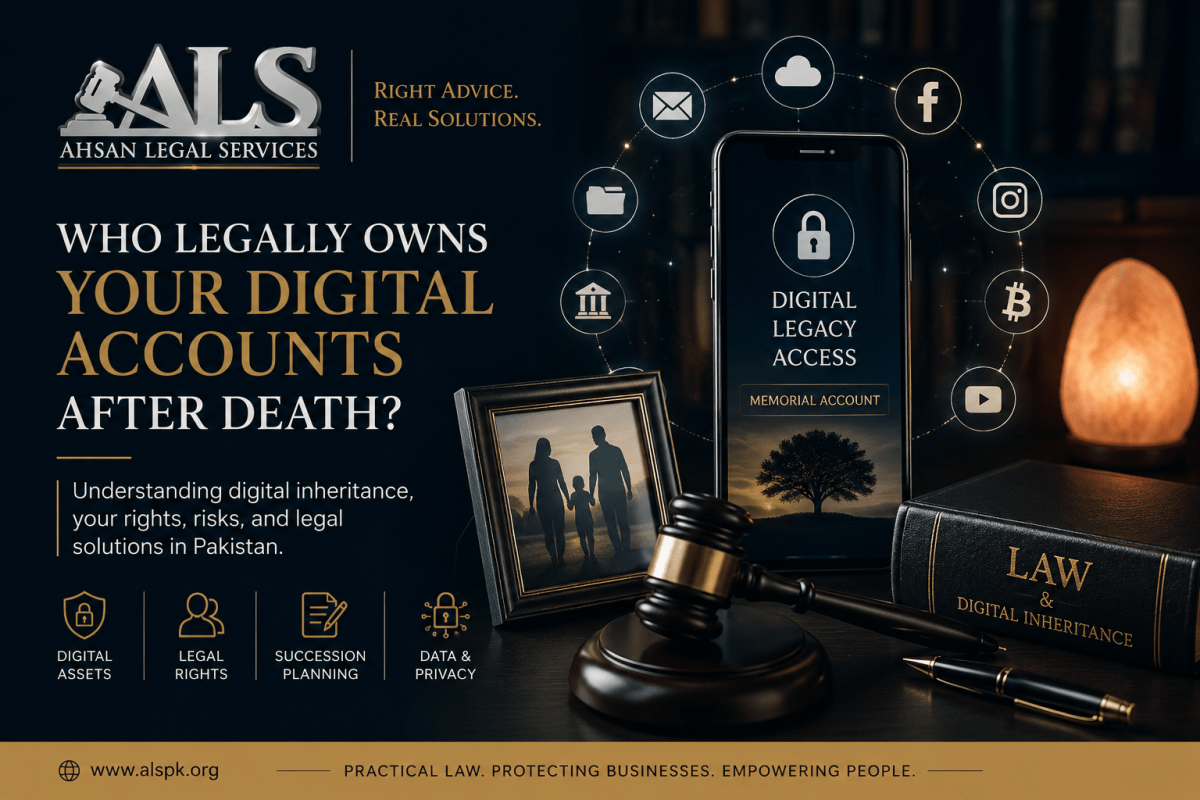
In today’s digital world, some of a person’s most valuable assets no longer exist in physical form. They exist online — in email accounts, cloud storage, social media profiles, cryptocurrency wallets, websites, business dashboards, and digital records. This has created an entirely new legal and business issue known as “digital inheritance.” Yet most individuals and businesses in Pakistan remain completely unprepared for what happens to these digital assets after death. Families often lose access to important information, businesses suffer operational disruption, valuable intellectual property disappears, and sensitive data becomes vulnerable simply because nobody planned for digital succession.
Digital assets today include far more than social media accounts. They may consist of cloud-stored business files, online banking access, cryptocurrency, YouTube channels, websites, e-commerce accounts, client databases, password managers, and even AI-generated content. For entrepreneurs, professionals, executives, and content creators, these digital assets may hold significant financial and commercial value. However, after a person passes away, families frequently discover they cannot access essential records because passwords are unknown or two-factor authentication remains connected to the deceased person’s phone number or email account. Even where heirs may legally inherit certain assets, they may still remain technically unable to access them.
Social media and technology platforms have further complicated this issue. Major companies often maintain their own internal policies regarding deceased users. Some platforms allow memorialization of accounts, some provide limited legacy access, while others may permanently deactivate inactive accounts or prohibit password sharing entirely. This creates an unusual situation where private technology companies may practically control access to a deceased person’s digital identity. Globally, lawmakers are still debating whether digital accounts should be treated as inheritable property, private communication, or merely licensed access rights. Pakistan, like many jurisdictions, still lacks a comprehensive legal framework specifically addressing digital inheritance.
The issue becomes even more serious in the context of cryptocurrency and digital finance. If private wallet keys are lost after death, digital assets may become permanently inaccessible because no central authority exists to recover them. Unlike traditional banking systems, cryptocurrency often has no password recovery mechanism. Around the world, billions of dollars in digital assets are believed to have been lost simply because owners died without sharing access credentials. As more businesses and investors enter the digital economy, succession planning for digital assets is rapidly becoming a critical legal and financial concern.
Businesses themselves face major operational risks when digital systems are managed informally. Many companies unknowingly allow key executives or employees to maintain exclusive control over passwords, business accounts, social media pages, cloud storage, or client data. If access is tied to personal email accounts or private devices, the sudden death or departure of an individual can severely disrupt operations and expose confidential information. In some cases, businesses effectively lose control of their own digital infrastructure. This is why modern organizations increasingly require digital succession planning, including centralized password management, emergency access protocols, multi-admin systems, cybersecurity contingency planning, and proper governance over digital assets.
The legal questions surrounding digital inheritance are becoming increasingly complex. Courts worldwide are beginning to confront issues such as whether social media accounts can be inherited, whether heirs should access private messages, who owns monetized online content after death, and whether privacy rights continue after a person dies. These disputes now intersect with succession law, contract law, privacy law, intellectual property law, employment law, and cybersecurity regulation. As digital economies continue expanding, such legal conflicts are expected to become far more common.
Beyond financial and corporate concerns, digital inheritance also carries a deeply human dimension. Online accounts often contain personal photographs, messages, memories, creative work, and emotional records that families may wish to preserve. At the same time, questions arise regarding whether private communications should remain confidential even after death. The law has not yet fully resolved the balance between inheritance rights and digital privacy.
The future of law is becoming increasingly digital. Lawyers are no longer dealing only with physical property, contracts, and litigation, but also with digital identities, online reputations, AI-generated assets, cloud ownership, cryptocurrency succession, and cyber access rights. In many ways, death no longer ends a person’s digital presence. The real legal question of the future may not simply be what a person owned — but who controls their digital existence afterward.
What do you think?
Should digital accounts automatically pass to legal heirs, or should digital privacy continue even after death?
 Ahsan Legal Services