
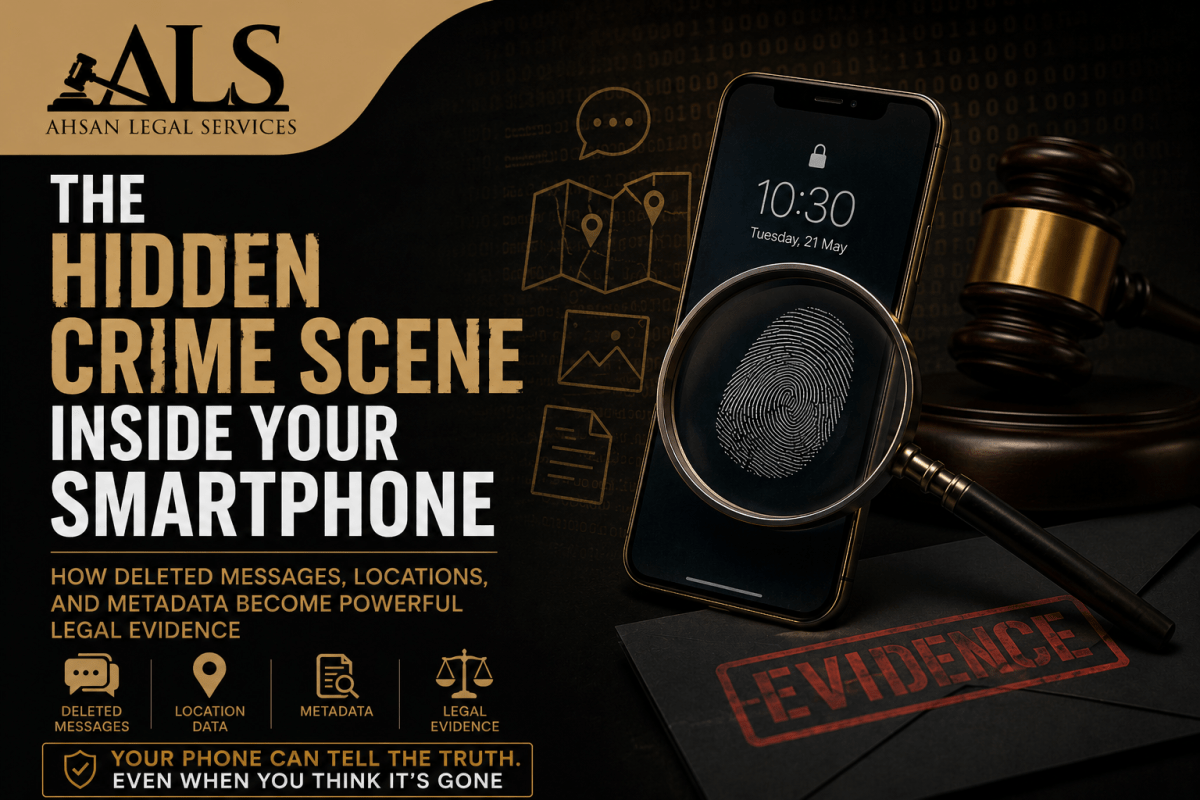
How Deleted Messages, Locations, and Metadata Become Powerful Legal Evidence
Most people think their smartphones are private spaces — filled with personal conversations, photographs, browsing history, and daily routines that disappear with a simple “delete” button. But in reality, modern smartphones are often silent witnesses to human behaviour.
Every call, message, search, location ping, Wi-Fi connection, screenshot, voice note, and social media interaction can leave behind digital traces. Even when users believe they have erased something forever, fragments of data may still survive in backups, cloud storage, application caches, server logs, or forensic recovery systems.
In today’s world, your smartphone can become a hidden crime scene. Courts, investigators, employers, cybercrime agencies, and forensic experts increasingly rely on mobile data as legal evidence in criminal investigations, corporate disputes, divorces, cybercrime cases, financial fraud, harassment complaints, and even murder trials.
Your Smartphone Knows More Than You Think
Most users underestimate the amount of information their devices continuously collect. A modern smartphone may store call logs, WhatsApp and social media conversations, GPS location history, search history, cloud backups, deleted photos and videos, app activity records, device connection logs, payment activity, contact history, metadata from photos and documents, and even biometric information.
Even ordinary photographs contain hidden metadata known as EXIF data, which may reveal the exact location, date, time, and device used to capture the image. This means that a single photo uploaded to social media can potentially place a person at a specific location at a specific time.
“Deleted” Does Not Always Mean Deleted
One of the biggest misconceptions in the digital world is the belief that deleting content permanently destroys it. In reality, deleted information often remains recoverable.
Digital forensic experts use specialised software and extraction tools to recover deleted messages, call records, images, videos, browser activity, file transfer history, location data, and cached application data. Sometimes data is not even recovered from the phone itself — but from cloud backups, synced devices, telecom providers, application servers, or connected computers.
This creates serious legal consequences for individuals involved in litigation or criminal investigations, especially where people assume deleted evidence can never return.
Real Case Example — How Smartphone Data Solved a Murder Investigation
One of the most widely discussed examples of smartphone forensic evidence emerged in the investigation surrounding the murder of journalist Jamal Khashoggi in 2018. Investigators reportedly analysed digital evidence including mobile communications, location tracking, and metadata connected to individuals involved in the incident. Digital forensic methods helped investigators reconstruct movements, timelines, and communications linked to the crime.
Similarly, in numerous criminal investigations worldwide, courts have relied on Google location history, WhatsApp chats, tower location data, fitness tracker movements, deleted SMS recovery, and cloud-stored photographs to establish timelines and identify suspects.
In several murder cases in the United States and Europe, prosecutors successfully used smartphone location records to contradict false alibis provided by suspects. A person may claim to have been “at home,” while mobile tower records, GPS logs, or ride-hailing application history place them somewhere entirely different. In such situations, the phone itself becomes a silent witness.
WhatsApp Chats Are Increasingly Used in Courts
Many people casually share threats, confidential information, fake allegations, or private content through messaging applications believing those conversations remain private forever. However, courts in many jurisdictions increasingly accept digital communications as evidence, subject to evidentiary rules and authenticity requirements.
WhatsApp messages have appeared in harassment cases, defamation claims, divorce disputes, corporate fraud investigations, workplace misconduct inquiries, blackmail matters, and extortion prosecutions. Even disappearing messages may not fully protect users because screenshots, backups, notifications, or forensic recovery techniques can preserve evidence long after conversations appear deleted.
Metadata — The Invisible Evidence
Metadata is often more revealing than the actual content itself. A photograph may reveal where it was taken, a document may reveal who created it, an email may reveal originating IP addresses, and a phone may reveal movement patterns stretching over months.
In cybercrime investigations, metadata frequently helps investigators reconstruct timelines and establish connections between individuals. Many people never realise they are constantly generating invisible digital evidence throughout their daily lives.
Legal and Privacy Concerns
The increasing use of smartphone forensic evidence raises serious privacy questions. Can authorities access your phone without consent? Can employers monitor employee devices? Can private chats be leaked or used publicly? Can screenshots become evidence?
Different countries apply different legal standards regarding digital privacy, consent, surveillance, and admissibility of electronic evidence.
In Pakistan, electronic evidence may be considered under laws including the role of the National Cyber Crime Investigation Agency (NCCIA), which investigates cyber offences, digital fraud, online harassment, hacking, and electronic crimes involving smartphones, social media platforms, and digital communications.
Relevant laws include the Qanun-e-Shahadat, 1984, particularly Articles 59 and 164 relating to electronic evidence, the Prevention of Electronic Crimes Act (PECA) 2016 governing cyber offences, the Investigation for Fair Trial Act, 2013 permitting authorised surveillance under judicial approval, and provisions under the Pakistan Telecommunication (Re-organization) Act, 1996 requiring telecom operators to assist investigative agencies where legally necessary.
Pakistani courts have increasingly relied on smartphone and digital evidence in both criminal and civil proceedings. In the high-profile murder case of social media personality Qandeel Baloch, investigators reportedly examined mobile phone records, social media activity, and communication history to reconstruct events leading to her killing.
Similarly, in cyber harassment and blackmail cases investigated by the FIA Cyber Crime Wing, WhatsApp chats, Facebook messages, screenshots, IP logs, and mobile extraction reports are routinely used to identify suspects and support prosecutions under PECA.
Pakistani family courts have also seen growing reliance on screenshots, call records, and messaging history in divorce, custody, and maintenance disputes, particularly where allegations of abuse, threats, or infidelity are involved.
In financial fraud investigations, banking applications, transaction alerts, OTP records, and mobile wallet activity have become critical evidence in tracing unauthorised transfers and online scams.
Today, digital forensic laboratories in Pakistan — including facilities operated by the FIA, NCCIA, and Punjab Forensic Science Agency (PFSA) — regularly perform mobile phone extraction, deleted data recovery, SIM analysis, and metadata examination in criminal investigations.
As technology evolves faster than legislation, courts worldwide continue struggling to balance privacy rights with investigative needs.
The Future of Digital Investigations
Artificial intelligence, cloud storage, wearable devices, smart homes, and connected vehicles are rapidly expanding the scope of digital evidence. Tomorrow’s investigations may rely not only on smartphones, but also smartwatch health data, vehicle GPS systems, voice assistants, smart doorbells, cloud AI assistants, and facial recognition systems.
The concept of a “crime scene” is no longer limited to physical spaces. Today, the most important evidence may exist inside a pocket-sized device carried everywhere.
The Digital Reality We Can No Longer Ignore
Your smartphone is more than a communication tool. It is a digital diary, location tracker, behavioural archive, financial record, and personal history combined into one device.
In legal disputes and criminal investigations, it can become one of the strongest forms of evidence — even when users believe the information has disappeared forever.
The next time someone presses “delete,” they should remember one thing clearly:
Digital footprints rarely vanish completely.
“`

