
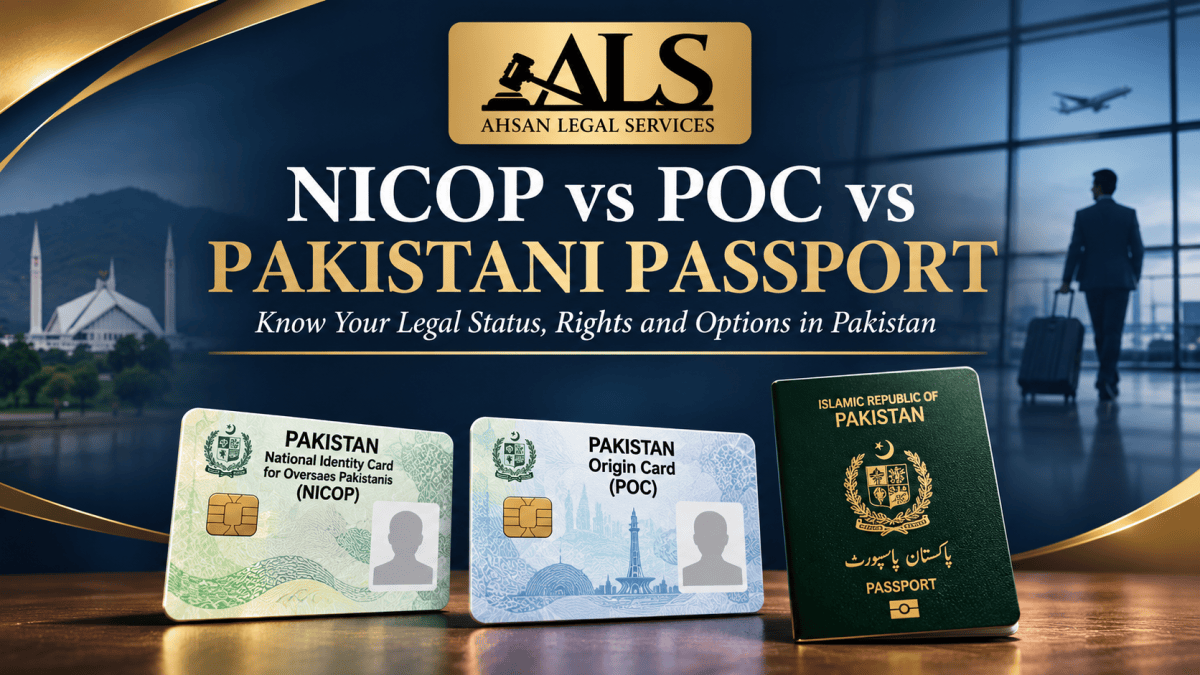
A Complete Legal Guide for Pakistanis Living Abroad and Foreign Nationals of Pakistani Origin
For millions of people living outside Pakistan, maintaining a legal connection with their country of origin is important. Whether it is visiting family, purchasing property, inheriting ancestral assets, managing a business, or dealing with official matters in Pakistan, having the correct identity and travel documents can make a significant difference.
However, one question frequently causes confusion among overseas Pakistanis and people of Pakistani origin:
What is the difference between NICOP, POC and a Pakistani passport?
Many people mistakenly believe that these three documents serve the same purpose. Others assume that obtaining a foreign nationality automatically means losing all rights in Pakistan. Some believe that a Pakistan Origin Card (POC) makes its holder a Pakistani citizen, while others are unaware that a person holding dual nationality may still be eligible for a Pakistani passport and NICOP.
These assumptions can lead to unnecessary complications, particularly when dealing with property transactions, inheritance, immigration, banking and other legal matters.
This article explains the legal status, purpose, eligibility, rights and limitations of NICOP, POC and Pakistani passports under the applicable Pakistani legal framework.
1. What Is NICOP (National Identity Card for Overseas Pakistanis)?
The National Identity Card for Overseas Pakistanis, commonly known as NICOP, is an official identity document issued by the National Database and Registration Authority (NADRA) to Pakistani citizens residing abroad.
NICOP is designed to facilitate the identification of Pakistani citizens who live, work or otherwise reside outside Pakistan.
It serves as official proof of identity and Pakistani nationality for eligible overseas Pakistanis. It also facilitates travel to Pakistan without obtaining a separate Pakistani visa.
Who is eligible for NICOP?
Generally, the following individuals may qualify:
- Pakistani citizens who are living or working abroad.
- Pakistani citizens holding dual nationality of a country recognised under Pakistan’s dual-nationality arrangements.
- Pakistani citizens intending to reside outside Pakistan for an extended period.
- Children born abroad to Pakistani parents who are eligible for Pakistani citizenship and registration.
Importantly, NICOP is not restricted to people who have permanently settled abroad. A Pakistani citizen living overseas for employment, education or other purposes may also qualify, subject to NADRA’s requirements.
What rights does a NICOP holder enjoy?
A valid NICOP provides several practical benefits:
1. Recognition as a Pakistani citizen
NICOP is an identity document issued to Pakistani citizens. It is not merely a residence or immigration card.
2. Visa-free entry into Pakistan
A valid NICOP holder can enter Pakistan without obtaining a Pakistani visa, subject to applicable immigration requirements.
3. Property ownership
A NICOP holder retains the rights associated with Pakistani citizenship, including the ability to purchase, own, sell and transfer property in accordance with applicable laws.
4. Inheritance rights
A Pakistani citizen does not lose inheritance rights merely because he or she resides abroad. A NICOP holder may claim an inheritance in Pakistan, subject to the applicable personal law and succession framework.
5. Banking and financial transactions
NICOP facilitates identity verification for banking and other financial transactions, subject to the relevant bank’s regulatory and documentation requirements.
6. Application for a Pakistani passport
An eligible NICOP holder can apply for a Pakistani passport. NICOP and a Pakistani passport, however, remain two separate documents serving different purposes.
Does a NICOP holder need a Pakistani passport to enter Pakistan?
Not necessarily.
A person holding a valid NICOP can generally travel to Pakistan without obtaining a Pakistani visa. A dual national may also use the passport of the other nationality for international travel, subject to airline, immigration and applicable documentation requirements.
However, NICOP should not be confused with a travel document. It does not replace a passport for ordinary international travel to other countries.
2. What Is POC (Pakistan Origin Card)?
The Pakistan Origin Card (POC) is a separate identity document issued by NADRA to eligible foreign nationals who have Pakistani origin or qualify through specified family relationships.
Unlike NICOP, POC is generally intended for individuals who are no longer Pakistani citizens but maintain a genuine legal or family connection with Pakistan.
For example, a person who was previously a Pakistani citizen but subsequently renounced Pakistani nationality after acquiring foreign nationality may qualify for a POC, subject to the applicable eligibility requirements.
Certain foreign nationals married to Pakistani citizens and other qualifying individuals may also be eligible.
Who can apply for POC?
Eligibility may include:
- Former Pakistani citizens who have formally renounced Pakistani nationality.
- Foreign nationals whose parents or grandparents were Pakistani citizens, subject to NADRA’s applicable eligibility rules.
- Foreign spouses of Pakistani citizens, subject to the relevant requirements.
- Other foreign nationals falling within the categories recognised under the Pakistan Origin Card Rules.
It is important to understand that merely having a Pakistani surname, cultural connection or distant family association does not automatically establish eligibility. NADRA determines eligibility on the basis of the prescribed legal criteria and supporting documentation.
What rights and facilities does a POC holder enjoy?
A POC provides significant facilities to foreign nationals of Pakistani origin.
These generally include:
1. Multiple visa-free entry into Pakistan
A valid POC allows its holder to enter Pakistan without obtaining a separate visa, subject to the applicable rules.
2. Indefinite stay in Pakistan
POC holders enjoy the facility of staying in Pakistan without the ordinary visa-related restrictions applicable to foreign visitors, during the validity of their card.
3. Property ownership and transactions
POC holders are permitted to purchase, own, sell, transfer and otherwise deal with movable and immovable property in Pakistan, subject to applicable laws and restrictions.
4. Banking facilities
POC holders can open and operate bank accounts in Pakistan, subject to banking regulations and the bank’s customer due diligence requirements.
5. Employment opportunities
POC holders enjoy employment-related facilities in Pakistan, subject to applicable laws, professional licensing and other regulatory requirements.
6. Identity verification
A valid POC serves as an officially recognised identity document for its holder in Pakistan, within the scope of the applicable rules.
Does holding a POC make someone a Pakistani citizen?
No.
This is perhaps the most important distinction between NICOP and POC.
A POC does not confer Pakistani citizenship. It does not make its holder a Pakistani national and does not entitle the holder to a Pakistani passport.
A POC holder remains a foreign national, although the card provides important immigration, identity, property and other facilities in Pakistan.
3. What Is a Pakistani Passport?
A Pakistani passport is an official travel document issued by the Directorate General of Immigration and Passports (DGI&P), Ministry of Interior, Government of Pakistan.
Unlike NICOP and POC, which primarily serve identity and facilitation purposes, a Pakistani passport establishes the holder’s entitlement to travel internationally as a Pakistani passport holder.
An ordinary Pakistani passport is issued to Pakistani citizens who satisfy the applicable requirements.
Pakistani passports are available in different categories, including:
- Ordinary passport.
- Official passport.
- Diplomatic passport.
For most overseas Pakistanis, the ordinary passport is the relevant category.
Who can obtain a Pakistani passport?
Generally, Pakistani citizens holding valid identity documentation issued by NADRA, such as CNIC, NICOP or an eligible Smart National ID Card, can apply for a Pakistani passport.
This includes eligible dual nationals, subject to applicable Pakistani nationality and passport requirements.
A person who has formally renounced Pakistani citizenship and holds only foreign nationality cannot ordinarily obtain a Pakistani passport merely on the basis of having Pakistani ancestry or holding a POC.
Does a Pakistani passport prove Pakistani citizenship?
A Pakistani passport is issued to Pakistani citizens and serves as an important official document of nationality and identity.
However, questions concerning citizenship, renunciation, restoration or dual nationality must ultimately be determined under the applicable citizenship laws and official records. A passport should not be treated as a substitute for examining the legal status of a person where nationality is disputed.
4. NICOP vs POC vs Pakistani Passport: What Is the Actual Difference?
The following comparison should help clarify the position:
| Feature | NICOP | POC | Pakistani Passport |
| Issuing authority | NADRA | NADRA | DGI&P |
| Pakistani citizenship required? | Yes | No | Yes |
| Primarily an identity document? | Yes | Yes | Primarily a travel document |
| Visa-free entry into Pakistan | Yes | Yes | As a Pakistani passport holder |
| Can holder apply for Pakistani passport? | Yes, if otherwise eligible | No, unless Pakistani citizenship is lawfully reacquired | Already holds one |
| Property ownership | Yes | Yes, subject to applicable laws | Yes, if holder is a Pakistani citizen |
| Inheritance rights | Yes, under applicable law | May inherit under applicable law | Yes, if holder is a Pakistani citizen |
| Available to foreign nationals of Pakistani origin? | No, unless Pakistani citizens | Yes, if eligible | No, unless Pakistani citizens |
The essential distinction is simple:
- NICOP identifies an overseas Pakistani citizen.
- POC identifies an eligible foreign national of Pakistani origin.
- A Pakistani passport is the international travel document issued to Pakistani citizens.
These documents are not interchangeable, and choosing the correct one depends on the applicant’s actual nationality and legal circumstances.
5. Can a Pakistani Citizen Hold Dual Nationality?
One of the most frequently asked questions by overseas Pakistanis concerns dual nationality.
Many Pakistanis have acquired citizenship of countries such as the United Kingdom, United States, Canada, Australia and several European states. They are often concerned about whether acquiring another nationality automatically deprives them of their Pakistani citizenship.
Pakistan’s citizenship framework is primarily governed by the Pakistan Citizenship Act, 1951, together with the applicable rules and government notifications.
Section 14 of the Pakistan Citizenship Act deals with the restriction on dual nationality, subject to statutory exceptions and arrangements recognised by the Government of Pakistan.
Pakistan has dual-nationality arrangements with 22 countries, as listed by the Directorate General of Immigration and Passports. These include:
- United Kingdom
- United States of America
- Canada
- Australia
- New Zealand
- France
- Italy
- Belgium
- Germany
- Netherlands
- Switzerland
- Sweden
- Norway
- Denmark
- Finland
- Ireland
- Iceland
- Luxembourg
- Bahrain
- Egypt
- Jordan
- Syria
The list should always be checked against the latest official notification before taking any decision concerning nationality.
What does this mean in practical terms?
A Pakistani citizen who acquires the nationality of a country covered by Pakistan’s recognised dual-nationality arrangements may generally retain Pakistani citizenship without being required to renounce it, subject to the applicable legal conditions.
Such a person may remain eligible for:
- Pakistani CNIC or NICOP.
- Pakistani passport.
- Ownership of property in Pakistan.
- Inheritance and succession rights.
- Other rights and obligations associated with Pakistani citizenship.
However, acquiring nationality of a country outside the recognised arrangements may raise questions under Section 14 and other applicable provisions. The precise legal consequences depend on the person’s circumstances, the relevant statutory exceptions and any applicable government arrangements.
Therefore, anyone considering foreign naturalisation should obtain proper advice before assuming that Pakistani citizenship will automatically continue.
6. What Happens If You Have Renounced Pakistani Citizenship?
Some overseas Pakistanis formally renounce their Pakistani nationality after acquiring citizenship of another country.
This is different from merely obtaining foreign nationality.
Where Pakistani citizenship has been formally renounced and the renunciation has been accepted or recorded in accordance with the applicable legal procedure, the individual no longer enjoys the status of a Pakistani citizen.
Nevertheless, this does not necessarily mean that the person loses every legal connection or entitlement in Pakistan.
An eligible former Pakistani citizen may apply for a Pakistan Origin Card.
A valid POC provides important facilities, including entry into Pakistan, property transactions, banking and other recognised privileges.
However, a POC does not restore Pakistani citizenship.
A former Pakistani citizen wishing to regain Pakistani nationality must examine the applicable provisions and procedure for resumption or reacquisition of citizenship. This should not be assumed to happen automatically through the issuance or renewal of a POC.
7. Can Children Born Abroad to Pakistani Parents Obtain NICOP and Pakistani Citizenship?
This is another important issue for overseas Pakistani families.
Children born outside Pakistan to Pakistani parents may be eligible for Pakistani citizenship by descent under the Pakistan Citizenship Act, 1951, subject to the statutory requirements.
The applicable rules depend, among other things, on the date and place of birth, the nationality and circumstances of the parent, and whether the parent was a citizen by descent or otherwise.
In general, parents should ensure that the birth of their child is properly documented and that the necessary registration and NADRA formalities are completed.
Eligible children may apply for NICOP through NADRA.
Why is this important?
Obtaining appropriate Pakistani documentation for children can help with:
- Establishing Pakistani identity and nationality.
- Travelling to Pakistan.
- Maintaining family records.
- Inheritance and succession matters.
- Obtaining a Pakistani passport, where eligible.
- Dealing with NADRA and other government departments.
Parents should not assume that a child’s foreign birth certificate alone automatically completes all Pakistani registration requirements.
Where one parent is a Pakistani citizen and the other is a foreign national, the child’s eligibility should be assessed under the applicable citizenship provisions.
8. Can NICOP or POC Holders Purchase Property in Pakistan?
Property ownership is one of the most important concerns for overseas Pakistanis and foreign nationals of Pakistani origin.
The good news is that both NICOP and POC holders enjoy facilities relating to the ownership and transfer of property in Pakistan.
However, their legal status is different.
A NICOP holder is a Pakistani citizen. Accordingly, the person enjoys the property rights available to Pakistani citizens, subject to applicable laws.
A POC holder is a foreign national but is granted property-related facilities under the Pakistan Origin Card framework.
Nevertheless, holding either card does not exempt a person from compliance with:
- Applicable land and property laws.
- Registration requirements.
- Stamp duty and taxation.
- Housing society rules and transfer procedures.
- Restrictions applicable to particular categories of land.
- Applicable foreign investment or sector-specific regulations.
Practical advice: Before purchasing property in Pakistan, overseas buyers should independently verify the ownership record, title documents, encumbrances, litigation history and authority of the seller or attorney.
Possession of a NICOP or POC does not guarantee that the property being purchased has a clear title.
9. Can a POC Holder Inherit Property in Pakistan?
Yes. A foreign national does not automatically lose the right to inherit property in Pakistan merely because of foreign nationality.
However, the applicable law of succession, the deceased person’s personal law, the nature of the property and the legal status of the heirs must be considered.
For example, a former Pakistani citizen who has acquired foreign nationality and holds a valid POC may still have inheritance rights in the estate of a deceased parent or other relative.
Similarly, a Pakistani citizen living abroad with NICOP does not lose inheritance rights because of residence outside Pakistan.
It is important to distinguish between the right to inherit and the procedure for transferring inherited property.
Depending on the circumstances, the heirs may need to obtain:
- A succession certificate for movable assets.
- A letter of administration for immovable assets.
- A legal-heirship or family-registration record, where relevant.
- Mutation or transfer of inherited property.
- Court orders where the inheritance is disputed.
The precise procedure depends upon the applicable law and the nature of the estate.
10. Can an Overseas Pakistani Apply for NICOP or Renew a Pakistani Passport Online?
NADRA provides online application facilities through its Pak Identity platform for eligible identity-document services, including NICOP and POC.
Applicants can generally apply for:
- New NICOP.
- NICOP renewal.
- Modification or correction.
- Reprint in case of loss or damage.
- New POC.
- POC renewal and modification.
The applicant may be required to provide supporting documents, photographs, biometric information and verification depending on the nature of the application.
For Pakistani passports, DGI&P also provides online services for eligible overseas applicants, including passport renewal and certain other categories.
However, first-time passport applications, identity discrepancies and certain cases involving nationality verification may require personal appearance or additional documentation.
Applicants should always consult the current requirements of NADRA and DGI&P before submitting an application.
11. Common Mistakes Overseas Pakistanis Should Avoid
Despite the availability of online facilities, people frequently make avoidable mistakes when dealing with Pakistani identity and nationality documentation.
Some of the most common include:
Mistake 1: Assuming NICOP and POC are the same.
They are not. NICOP is for Pakistani citizens, whereas POC is for eligible foreign nationals of Pakistani origin.
Mistake 2: Assuming foreign nationality automatically terminates Pakistani citizenship.
The legal consequences depend on Section 14 of the Pakistan Citizenship Act, applicable exceptions and the recognised dual-nationality arrangements.
Mistake 3: Assuming a POC holder can obtain a Pakistani passport.
A POC does not confer Pakistani citizenship and cannot, by itself, establish eligibility for a Pakistani passport.
Mistake 4: Ignoring discrepancies in NADRA records.
Differences in names, dates of birth, parentage or marital status can create serious complications in identity verification and passport applications.
Mistake 5: Failing to register children born abroad.
Parents should ensure that eligible children are properly documented under Pakistani law.
Mistake 6: Assuming that NICOP or POC guarantees a clear property title.
Neither document substitutes for proper verification of ownership and legal title.
Mistake 7: Relying on informal advice concerning renunciation of nationality.
Renunciation is a serious legal matter. Before proceeding, individuals should understand its consequences for citizenship, passports and other rights.
12. When Should You Consult a Pakistani Lawyer?
Although NICOP, POC and passport applications are largely administrative matters, certain situations require proper legal advice.
You should consider consulting a Pakistani lawyer if:
- You are uncertain whether you remain a Pakistani citizen after acquiring foreign nationality.
- You have formally renounced Pakistani citizenship but wish to regain it.
- NADRA has refused your NICOP or POC application.
- Your identity records contain conflicting particulars.
- You need to establish the Pakistani citizenship of a child born abroad.
- You face complications in purchasing, selling or inheriting property in Pakistan.
- You require legal representation in Pakistan while residing overseas.
- You need advice regarding the legal consequences of acquiring a particular foreign nationality.
The distinction between an identity-document issue and a citizenship issue is particularly important. A person should not make decisions about nationality solely on the basis of an expired card, an old passport or informal advice.
Conclusion: Know Your Legal Status Before Choosing Your Document
NICOP, POC and a Pakistani passport serve different legal purposes. Understanding these differences is essential for anyone who wants to maintain a lawful and secure connection with Pakistan while living abroad.
If you are a Pakistani citizen residing overseas, NICOP may be the appropriate identity document. If you have formally renounced Pakistani nationality but retain a qualifying Pakistani origin, POC may provide important facilities. If you remain a Pakistani citizen and wish to travel internationally as a Pakistani national, a Pakistani passport is the relevant travel document.
Ultimately, the correct document depends on your actual nationality, personal circumstances and the applicable laws of Pakistan.
Do not confuse Pakistani origin with Pakistani citizenship. They are legally different concepts.
Need Legal Assistance in Pakistan?
Whether you are living in the United Kingdom, United States, Canada, UAE, Saudi Arabia or another country, distance should not prevent you from understanding or protecting your legal rights in Pakistan.
Ahsan Legal Services (ALS) provides legal assistance and guidance in matters involving:
- Pakistani citizenship and identity documentation.
- NICOP and POC-related legal guidance.
- Property ownership and disputes.
- Inheritance and succession.
- Power of Attorney and legal documentation.
- Civil, family and criminal litigation.
- Legal opinions and representation in Pakistan.
Ahsan Legal Services (ALS)
All Legal Services Under One Roof
Legal Disclaimer: This article is intended for general legal awareness and educational purposes. It does not constitute individual legal advice. Eligibility, rights and procedures may vary depending on individual circumstances, applicable legislation and subsequent government notifications. Applicants should verify current requirements with NADRA, the Directorate General of Immigration and Passports and the relevant Pakistani authorities before taking any legal or administrative action.

