Categories
Uncategorized

What To Do If Police Refuse to Register Your FIR in Pakistan – Legal Remedies

In Pakistan, the First Information Report (FIR) is the first step in the criminal justice process. Under the law, police are required to register an FIR when information about a cognizable offence is provided.

However, many citizens face situations where the police refuse to register their FIR. Fortunately, Pakistani law provides several remedies to ensure that justice is not denied.

Below are the legal options available if the police refuse to register an FIR.


1. Submit a Written Complaint to the SHO

The first step is to submit a written application to the Station House Officer (SHO) of the concerned police station.

The complaint should include:

  • Full name and address
  • Details of the incident
  • Date, time and location
  • Names of accused (if known)

Always keep a copy of the application for record.


2. Approach Senior Police Officers

If the SHO refuses to register the FIR, you can approach higher police authorities such as:

  • SDPO
  • DSP
  • DPO
  • CCPO / RPO

Senior officers have the authority to order registration of the FIR.


3. File an Application Under Section 22-A CrPC

One of the most effective legal remedies is to file an application under Section 22-A CrPC before the Justice of Peace (usually the Sessions Judge or Additional Sessions Judge).

The court may:

  • Direct police to register the FIR
  • Order an inquiry
  • Ensure lawful action by the police

This is a commonly used legal remedy in Pakistan.


4. Send Complaint Through Registered Post

Another option is sending a complaint to the police station or senior officers through registered post or courier. This creates an official record of your complaint.


5. File a Private Criminal Complaint

If police still fail to take action, a person may file a private criminal complaint directly before the Magistrate.

The court may then:

  • Record evidence
  • Summon the accused
  • Start criminal proceedings

Important Legal Principle

Under Pakistani criminal law, police cannot refuse to register FIR in cases involving cognizable offences. If they do, the aggrieved person has the right to approach the courts.

Legal awareness empowers citizens to protect their rights and seek justice through lawful means.

Categories
Uncategorized

Weekly Law News Update (07-03-2026)

⚖️ Ahsan Legal Services

Court Decisions • Legal Developments • Legal Awareness

🏛️ Supreme Court Moves to Protect Witnesses from Abusive Cross-Examination

The Supreme Court has emphasized that witnesses must be treated with dignity during trial proceedings and warned against abusive or humiliating cross-examination practices. Trial courts have been advised to intervene where questioning becomes oppressive or irrelevant.

📌 Legal Insight: Courts have the authority to control cross-examination to ensure fairness and protect witnesses from harassment.

Ahsan Legal Services

👩‍⚖️ Lahore High Court: Women May File Khula Cases in Their District of Residence

The Lahore High Court ruled that women can file khula and haq-mehr cases in the district where they reside, making access to justice easier and reducing unnecessary hardship.

📌 Legal Insight: Family courts should facilitate litigants and avoid forcing women to travel to distant jurisdictions.

Ahsan Legal Services

⚖️ Three Civil Judges Dismissed Over Misconduct

The Lahore High Court has dismissed three civil judges from Lahore, Rawalpindi, and Jhelum after misconduct allegations were proven through an inquiry.

📌 Legal Insight: Judicial accountability mechanisms ensure integrity and discipline within the judiciary.

Ahsan Legal Services

🏛️ Federal Constitutional Court Reinforces Finality of Supreme Court Judgments

The Federal Constitutional Court has clarified that parallel appeals cannot be filed against decisions of the Supreme Court, emphasizing that litigation must eventually come to an end.

📌 Legal Insight: The Supreme Court remains the final authority on constitutional interpretation in Pakistan.

Ahsan Legal Services

📜 Supreme Court Reviews Scope of Presidential Clemency Powers

The Supreme Court’s Shariat Appellate Bench has sought legal assistance regarding the extent of the President’s and Governors’ powers to grant pardons or sentence remissions under Qisas and Diyat laws.

📌 Legal Insight: The decision may clarify limits of executive clemency in criminal cases involving Islamic criminal law.

Ahsan Legal Services

📢 Legal Tip of the Week

Before purchasing property, always verify:

✔ Approved housing scheme status
✔ Ownership documents
✔ Pending litigation or encumbrances

📌 Proper due diligence can prevent years of litigation.Ahsan Legal Services

Categories
Uncategorized

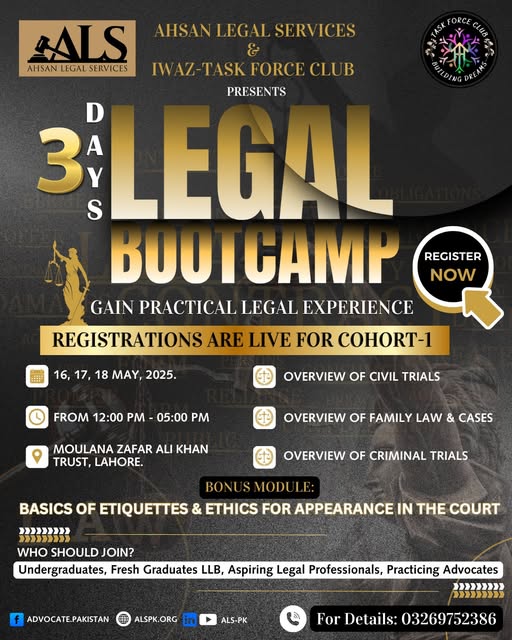
3-DAYS LEGAL BOOTCAMP – COHORT 1

Categories
Uncategorized

Principles under The Punjab Pre-emption Act 1991

Categories
Uncategorized

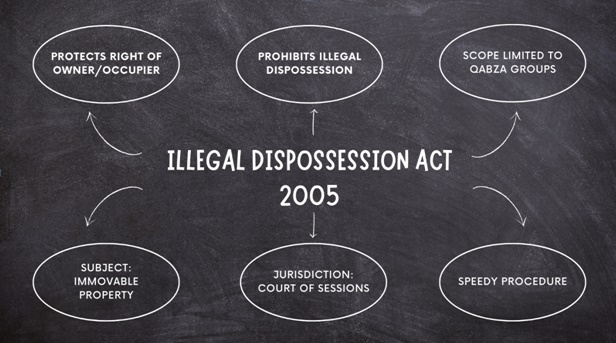
Understanding the Illegal Dispossession Act, 2005

Categories
Uncategorized

West Pakistan Family Courts Act 1964 – A Comprehensive Summary

(Compiled by our fellows namely: Mariah Khurshid, Raja Shoaib Wali, Ibrar Ahmad Khan and Fawad Khan. All students of Faculty of Law, University of Central Punjab, Lahore.)

The preamble of the West Pakistan Family Courts Act, 1964 (the “Act) states its purpose as settlement of the disputes in regards to marriage and family affairs.

The Act extends to the whole of Pakistan except the tribal areas. Section 5 provides for the Jurisdiction of the Family Court (the “Court”). Generally, the court will have special jurisdiction over the family matters including dissolution of marriage, dower, maintenance, restitution of conjugal rights, custody of children, guardianship, jactitation of marriage, etc. in addition to a few offenses of hurt, etc. arising out of family disputes. The Court is not bound to adopt ordinary and lengthy procedures of trial and evidence like ordinary Civil Courts to curtail the period.

The Court is also empowered to pass an interim order for the protection and preservation of property in dispute.

As per the Rules of 1965 under the Act, the plaint can be filed in the District where the cause of action wholly or in part has arisen or where the parties reside or last resided together. In suits for dissolution of marriage or dower, plaint can also be filed in the District, where the wife ordinarily resides.

The judge of the Court (the “Judge”) has to have the qualification to be appointed as District Judge or an Additional District Judge. The judges are to be appointed by the Government in every district including at least one women Judge. The Judges are also equipped with the power of the Judicial Magistrate’s 1st class.

For the Act, Family Court is deemed to be District Court, whereas, District Judge or Government may determine the place of sitting of the Court.

According to the Act, every suit is to be initiated by filing a plaint containing material facts along with a schedule stating the particulars of witnesses intended to be a procedure in support. Also, the parties may call any witness at any later stage if the Court deems it necessary in the interest of justice. It is also mandatory to file the list of documents that are attached with the plaint as well as the documents to be produced later.

After receiving the plaint, the Court fixes a date within the next 30 days for the appearance of the defendant by serving the summons. The Court also sends notice of the suit to the defendant and to the chairman of the union council within whose jurisdiction the defendant resides, by registered post along with a copy of the plaint. On the date fixed the parties may make their appearance before the Court. 

A distinctive feature of the Act is that if the defendant (husband) is desirous of filing a suit for restitution of conjugal rights, he, instead of doing so, may claim this relief in the written statement of the plaint of dissolution of marriage, filed against him. By this, he does not need to file a separate suit, and his written statement, to the extent of claim of restitution of conjugal rights shall be treated as his plaint. Likewise, a defendant (wife) may also claim dissolution of marriage through her written statement of plaint claiming restitution of conjugal rights instead of a separate suit.

Further, if a defendant does not appear on the fixed date the court will proceed ex-Parte which the defendant may challenge within 30 days of the service of notice of passing out the decree.

Another weighty feature of the Act is the statutory obligation of the Court to make an active effort for reconciliation of the parties twice. Firstly, before proceeding with the formal trial once a written statement from the defendant is filed, and secondly, before pronouncement of judgment after the conclusion of the trial.

If after pre-trial conciliation efforts, no compromise is reached, the court shall frame the issues and fix the date for recording of evidence. Nevertheless, in a suit for dissolution of marriage, if such effort for compromise fails, the Court shall pass a decree for dissolution of marriage (if on ground of Khula) immediately and the husband will be entitled to restoration of a portion of dower (haq-mehr) if already paid or waiver thereof. Likewise after the recording of evidence of both parties the Court will make another attempt to affect a compromise between the parties, and in case of failure, the judgment will be announced.

The Court is bound to dispose of the case within 6 months from the date of the institution. If the case is not decided within this stipulation, either party may approach the High Court for appropriate order/direction.

Generally, the decree passed by the court is appealable. However, no appeal lies in the case of dissolution of marriage (except in few cases), for dower/dowry not exceeding Rs. 30,000 and for maintenance of Rs. 1,000 or less. Also, no right of appeal and revision against an interim order passed by the court exists. The appellate court is also to dispose of the appeal within 4 months.

If a person insults the Court, causes impediment in the work of the court, misbehaves with any person in court, refuses to answer any question put by the court, or refuses to take an oath he can also be held responsible for contempt of court.


Categories
Uncategorized

ALS SIGNED MOU WITH TOP RANKED UNIVERSITY

It is delightfully announced that ‘Ahsan Legal Services’ has entered into a Memorandum of Understanding with Faculty of Law, University of Central Punjab.

The MoU sets sight on formal academic internships in summers for Law students to observe and learn the practical application of legal knowledge and theories which they have acquire during their studies at campus.

ALS is a unique organization consisting a bouquet of professional and academia lawyers and former judges having command in their respective fields including litigation, transactional tasks, opinions and customized trainings.

Categories
Uncategorized

REJECTION OF PLAINT UNDER RULE 11, ORDER VII, CPC — GROUND OF LIMITATION.

As per rule 6 of Order VII, Code of Civil Procedure, 1908, where the suit is instituted after the expiration of the period prescribed by the law of limitation, the plaint shall show the ground upon which exemption from such law is claimed. And as per section 3 of the Limitation Act 1908, every suit instituted after the period of limitation shall be dismissed, although limitation has not been set up as a defence.In general, matter of limitation is treated as mixed question of law and facts to be decided after recording of evidence, however, in cases, where there is no FACTUAL controversy to the extent of matter of limitation, this question can be decided from bare perusal of plaint and annexed documents. And if suit appears to be hopelessly time barred after relevant law is applied on the facts/assertions mentioned in the plaint, the same can be rejected under rule 11, order VII, CPC. In a case reported as 2015 CLC 708, the Hon’ble Court has rejected the plaint under rule 11, order VII, CPC being barred by time.