Categories
Uncategorized

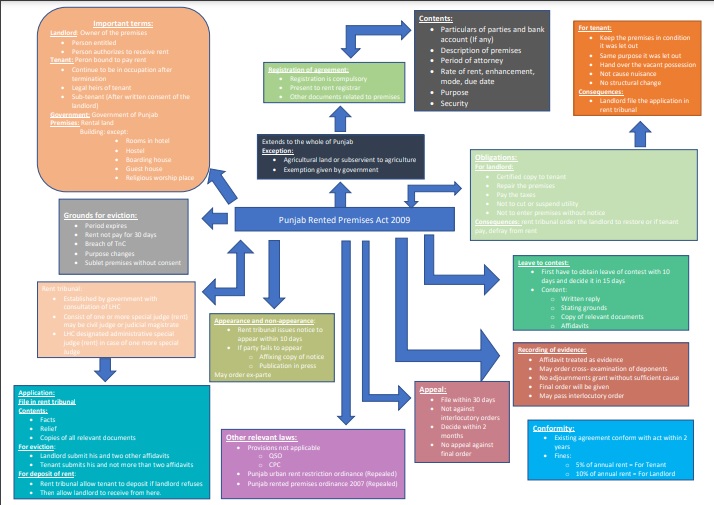
Extract of Punjab Rented Premises Act, 2009

(Compiled by our fellows namely: Meherzada Muhib, Hassan Majied, Sami Ullah and Haris Ali Sindhu. All students of Faculty of Law, University of Central Punjab, Lahore.)

While superceding the Punjab Rented Premises Ordinance, 2007, the Punjab Rented Premises Act, 2009 (the “Act”) ultimately substituted the old Punjab Urban Rent Restriction Ordinance, 1959 aiming to regulate the relationship of landlord and tenant in respect of rented premises in a better way. It is applicable to the urban areas within the territory of the Punjab, excluding any land exempted by the government.

The Act is substantive as well as procedural. Plain reading of the Act reveals that it endeavors to ensure maximum certainty apropos matters of tenancy. It lays down the rights and obligations of tenant and landlord; similarly it provides a procedure for the protection of these rights. The owner of premises and a person who is entitled or authorized to receive the rent is defined as landlord. Whereas, the Act declares any person who is bound to pay rent including person in occupation after termination of tenancy agreement, legal heirs, and subtenant (with consent) as tenant.  

In order to reduce the ambiguity regarding the relationship of tenant and landlord, the act declares registration of tenancy agreement before the Rent Registrar mandatory along the regular registration irrespective of its tenure. Otherwise, if a landlord desires to approach Rent Tribunal, he will have to deposit an amount equivalent to ten percent of the value of annual rent as penalty and in case of tenant, five percent as same penalty.

The Act has also provided the essential contents of tenancy agreement i.e. particulars of landlord and tenant, their bank accounts (if any), description of premises, period of tenancy, rate of rent, rate of enhancement (if any), mode of payment, due date, purpose of use and amount of security etc.

The Act has imposed certain statutory obligations on the landlord i.e. to provide a certified copy of the agreement to tenant, repair the rented premises and pay taxes. Besides, under the Act, it is also obligatory for the tenant not to change the structure, not to cause nuisance, handover vacant possession upon termination of an agreement, allow landlord to enter in the rented premises, use rented premises for the mentioned purpose and keep it in the condition in which it was let out.

The Act also declares grounds for the eviction i.e. expiration of tenancy period, rent is unpaid for thirty days, breach of any term or condition of agreement, use of premises for unmentioned purpose or subletting the rented premises without consent of the landlord.

 Moreover, to resolve disputes between landlord and tenant, Rent Tribunals have been established in every district by Punjab Government which are presided over by the Special Judges (Rent), who are appointed with the consultation of Lahore High Court and those Tribunals shall exercise exclusive jurisdiction over cases under the Act. In order to make the proceedings under the Act expedited, provisions of Qanun-e-Shahadat Order 1984 and Code of Civil Procedure, 1908 are also not applicable.

In order to defend the application, the respondent has to file an application for leave to contest within ten days, which shall be decided within fifteen days of its filing. The Rent Tribunal may pass ex-parte order in case of non-appearance of the party and against that ex-parte order, an application may be filed within ten days. The Rent Tribunal has to pass a final order on an application within four months and the aggrieved party may file an appeal against final order within thirty days, and if filed, the appeal shall be decided within two months.

Categories
Uncategorized

West Pakistan Family Courts Act 1964 – A Comprehensive Summary

(Compiled by our fellows namely: Mariah Khurshid, Raja Shoaib Wali, Ibrar Ahmad Khan and Fawad Khan. All students of Faculty of Law, University of Central Punjab, Lahore.)

The preamble of the West Pakistan Family Courts Act, 1964 (the “Act) states its purpose as settlement of the disputes in regards to marriage and family affairs.

The Act extends to the whole of Pakistan except the tribal areas. Section 5 provides for the Jurisdiction of the Family Court (the “Court”). Generally, the court will have special jurisdiction over the family matters including dissolution of marriage, dower, maintenance, restitution of conjugal rights, custody of children, guardianship, jactitation of marriage, etc. in addition to a few offenses of hurt, etc. arising out of family disputes. The Court is not bound to adopt ordinary and lengthy procedures of trial and evidence like ordinary Civil Courts to curtail the period.

The Court is also empowered to pass an interim order for the protection and preservation of property in dispute.

As per the Rules of 1965 under the Act, the plaint can be filed in the District where the cause of action wholly or in part has arisen or where the parties reside or last resided together. In suits for dissolution of marriage or dower, plaint can also be filed in the District, where the wife ordinarily resides.

The judge of the Court (the “Judge”) has to have the qualification to be appointed as District Judge or an Additional District Judge. The judges are to be appointed by the Government in every district including at least one women Judge. The Judges are also equipped with the power of the Judicial Magistrate’s 1st class.

For the Act, Family Court is deemed to be District Court, whereas, District Judge or Government may determine the place of sitting of the Court.

According to the Act, every suit is to be initiated by filing a plaint containing material facts along with a schedule stating the particulars of witnesses intended to be a procedure in support. Also, the parties may call any witness at any later stage if the Court deems it necessary in the interest of justice. It is also mandatory to file the list of documents that are attached with the plaint as well as the documents to be produced later.

After receiving the plaint, the Court fixes a date within the next 30 days for the appearance of the defendant by serving the summons. The Court also sends notice of the suit to the defendant and to the chairman of the union council within whose jurisdiction the defendant resides, by registered post along with a copy of the plaint. On the date fixed the parties may make their appearance before the Court. 

A distinctive feature of the Act is that if the defendant (husband) is desirous of filing a suit for restitution of conjugal rights, he, instead of doing so, may claim this relief in the written statement of the plaint of dissolution of marriage, filed against him. By this, he does not need to file a separate suit, and his written statement, to the extent of claim of restitution of conjugal rights shall be treated as his plaint. Likewise, a defendant (wife) may also claim dissolution of marriage through her written statement of plaint claiming restitution of conjugal rights instead of a separate suit.

Further, if a defendant does not appear on the fixed date the court will proceed ex-Parte which the defendant may challenge within 30 days of the service of notice of passing out the decree.

Another weighty feature of the Act is the statutory obligation of the Court to make an active effort for reconciliation of the parties twice. Firstly, before proceeding with the formal trial once a written statement from the defendant is filed, and secondly, before pronouncement of judgment after the conclusion of the trial.

If after pre-trial conciliation efforts, no compromise is reached, the court shall frame the issues and fix the date for recording of evidence. Nevertheless, in a suit for dissolution of marriage, if such effort for compromise fails, the Court shall pass a decree for dissolution of marriage (if on ground of Khula) immediately and the husband will be entitled to restoration of a portion of dower (haq-mehr) if already paid or waiver thereof. Likewise after the recording of evidence of both parties the Court will make another attempt to affect a compromise between the parties, and in case of failure, the judgment will be announced.

The Court is bound to dispose of the case within 6 months from the date of the institution. If the case is not decided within this stipulation, either party may approach the High Court for appropriate order/direction.

Generally, the decree passed by the court is appealable. However, no appeal lies in the case of dissolution of marriage (except in few cases), for dower/dowry not exceeding Rs. 30,000 and for maintenance of Rs. 1,000 or less. Also, no right of appeal and revision against an interim order passed by the court exists. The appellate court is also to dispose of the appeal within 4 months.

If a person insults the Court, causes impediment in the work of the court, misbehaves with any person in court, refuses to answer any question put by the court, or refuses to take an oath he can also be held responsible for contempt of court.

Categories
Uncategorized

ALS SIGNED MOU WITH TOP RANKED UNIVERSITY

It is delightfully announced that ‘Ahsan Legal Services’ has entered into a Memorandum of Understanding with Faculty of Law, University of Central Punjab.

The MoU sets sight on formal academic internships in summers for Law students to observe and learn the practical application of legal knowledge and theories which they have acquire during their studies at campus.

ALS is a unique organization consisting a bouquet of professional and academia lawyers and former judges having command in their respective fields including litigation, transactional tasks, opinions and customized trainings.

Categories
Uncategorized

Imposition of fine – unregistered rent agreement

Hon’ble Lahore High Court, Lahore while deciding a Constitutional Petition, decided the issue of imposition of fine on filing of each application before Rent Tribunals on the basis of same unregistered rent agreement. Founder of Ahsan Legal Services – ALS with active aid of team presented the case on behalf of respondents. The Hon’ble Court was pleased to grant relief to respondents while holding;

“ … Where tenancy between the parties was not in consonance with the provisions of Punjab Rented Premises Act, 2009, Rent Tribunal could not entertain an application until and unless the requisite fine had been deposited by the party approaching the said forum — Provision of S.9 of Punjab Rented Premises Act, 2009, did not suggest that fine would be leviable against a party only for once — Imposition of fine under S.9 of Punjab Rented Premises Act, 2009, was to encourage registration of tenancy between the parties — If parties had not opted to bring the tenancy in conformity with the provisions of Punjab Rented Premises Act, 2009, then they should face the consequences — Defect in tenancy would not be cured until and unless same was brought in conformity with the provisions of Punjab Rented Premises Act, 2009 — Once the party had deposited fine even then it could be burdened with fine again, if he had approached the Rent Tribunal with a fresh application …..”

The judgment has been published and reported as PLD 2020 Lahore 713.

Categories
Uncategorized

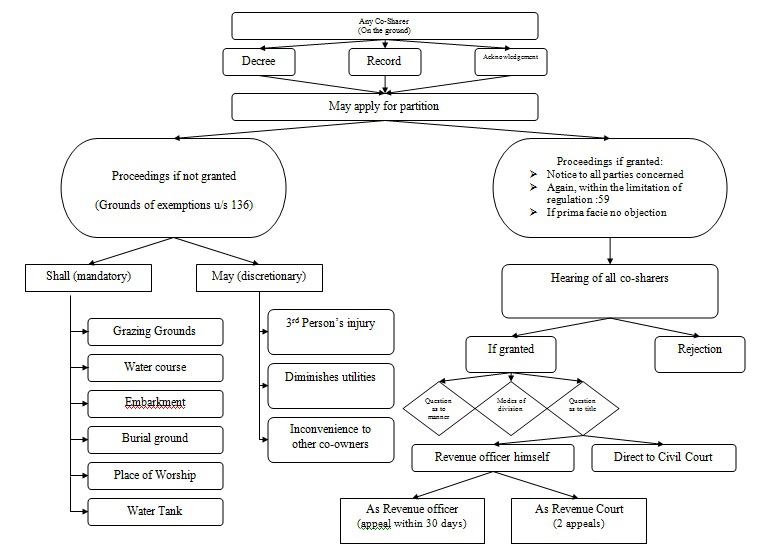
Partition of Land — Process in Graphical Form

Process of partition of agricultural land under the West Pakistan Land Revenue Act, 1967. Feel free to discuss through comments or ask through contact us.

Categories
Uncategorized

CHILD MARRIAGE —- AN OPEN ENDED DISCUSSION

Child marriage is defined as the marriage or union between two people in which one or both parties are younger than required age.UN Convention on the Rights of the Children (ratified by Pakistan) considered marriage below the age of eighteen as child marriage.The Child Marriage Restraint Act, 1929 is aimed to restrain the solemnization of child marriage and does not affect the validity of such marriage but imposes certain penalties. This Act also declared minimum age for marriage, if a male, as eighteen years, and if a female, as sixteen years The West Pakistan Muslim Personal Law (Shariat) Act, 1962 in its Section 2 states that notwithstanding any custom or usage, in all questions regarding betrothal, marriage, divorce, dower, adoption, guardianship, minority, legitimacy or bastardy, family relations, the rules of decision, subject to the provisions of any enactment for the time being in force, shall be the Muslim Personal Law (Shariat) in case where the parties are Muslims.According to Sharia (Law), a minor’s father has the right to marry him/her off to whomever he chose without consulting him/her as minors lack the legal capacity to give permission for marriage. However, this marriage could not be consummated until the minor child reached the age of majority. In the period between betrothal and the consummation of marriage, the young bride would reside with her parents. Upon attainment of the age of majority, the bride could exercise her right to annul the marriage if she so wished, this is called option of puberty.Age of majority was equated with attaining puberty and demonstrating adequate mental development. Council of Islamic Ideology (CII) has declared that the laws related to the minimum age of marriage were un-Islamic and that children of any age could get married if they attain puberty. There is no fixed age of puberty. The age to attain puberty is different in males and females, and even differs in male to male and female to female. The CII agreed on the age of fifteen for puberty, although according to the CII, a girl may reach puberty at the age of nine while boys may reach puberty as soon as twelve.

Categories
Uncategorized

BRIEF ON JUDICIAL, QUASI-JUDICIAL AND ADMINISTRATIVE ORDERS

In broad-spectrum, the word ‘order’ is used in the meaning of command, adjudge, to adjudicate, to instruct, to legislate, to lineup or manage etc. In legal sense, the word ‘order’ has no universal meaning. Different statutes define this expression differently. Yet the word ‘order’ has not been defined in the Act like the Code of Civil Procedure, 1908 which gives it a special meaning in order to distinguish it from a decree.Judicial Order:A judicial act seems to be an act done by a competent authority upon a consideration of facts and circumstances, and imposing liability, or affecting the rights of others.Judicial order is an order while exercising judicial authority nevertheless, to make an order a judicial order, the following criteria must be satisfied:i. it is in substance a determination upon investigation of a question by the application of objective standards to facts found in the light of pre-existing legal rules;ii. it declares rights or imposes upon parties obligations affecting their civil rights; andiii. the investigation is subject to certain procedural attributes, namely: (a) contemplating and opportunity of presenting its case to a party; (b) ascertainment of facts by means of evidence, if a dispute is on question of fact, and if the dispute is on question of Law, on the presentation of legal argument; (c) a decision resulting in the disposal of the matter on findings based upon these questions of Law and Fact.Quasi-Judicial Order:The word ‘Quasi’ is prefixed to a noun means that although the thing signified by the combination of ‘Quasi’ with the noun does not comply in strictness with the definition of the noun, it shares its qualities, falls philosophically under the same head, and is best marked by its approximation thereto.The prefix “Quasi” is derived from Latin roots meaning – similar to but not exactly. Thus Quasi-Judicial proceedings are similar, but not exactly Judicial or Court proceedings. Also, some Quasi-Judicial bodies may derive certain powers from certain Acts; yet they cannot be considered as Courts. In fact, the term Quasi-Judicial is employed to differentiate it from Judiciary or Court. ‘Quasi Judicial’ is a term applied to the action, discretion, etc, of public administrative officers or bodies, who are required to investigate facts, or ascertain the existence of facts, hold hearings, weigh evidence, and draw conclusions from them, as a basis for their official action, and to exercise discretion of a judicial nature.Quasi Judicial act is a judicial action performed by one not a judge. Quasi Judicial power is the power of an administrative agency to adjudicate the rights of persons before it.The term ‘Quasi Judicial Order’ has been given a liberal interpretation so as to include orders by tribunals or authorities other than the regular courts of justice. To constitute a Quasi-Judicial Order, the authority passing the order should be under an obligation to hear the parties, to make an inquiry, to weigh the evidence and to base its conclusion thereon. Its decision should be based on the result of the inquiry and not on its own discretion.Administrative Order:An ‘Administrative Order’ is an issuance by any agency under the executive branch of government.Governmental systems based on the English tradition are typically comprised of executive, legislative, and judiciary branches. The judicial system of courts and judges has the primary authority to interpret the law of the land in civil and criminal matters. Certain government agencies outside the judicial branch are established by statute to regulate aspects of life within a jurisdiction and are empowered to take the statute, that defines its authority and create working regulations to detail the procedures for complying with the law. The process of an agency issuing and enforcing regulations based on an authorizing statute is known as administrative law.Administrative order is an enforceable order issued by a public authority (under the powers conferred to it by one or more statutes) to an individual or an organization to take certain corrective action, or to refrain from an activity.In United States of America, when authorized by the Court, the Chief Judge may issue administrative orders of general scope which apply to all cases pending in the district and administrative orders of a more limited nature which apply to smaller groups of cases (E.D. Mich. LR 83.3).Judicial, Quasi Judicial and Administrative Order — Divergence:In Shri Sitaram Sugar Company v. Union of India (AIR 1990 SC 1277), the Indian Supreme Court held as under:-“52. The True position, therefore, is that any act of the repository of power, whether legislative or administrative or quasi-judicial, is open to challenge if it is in conflict with the Constitution or the governing Act or the general principles of the law of the land or it is so arbitrary or unreasonable that no fair minded authority could ever have made it.”If the statutory authority is allowed to pass an order subjectively, based on his personal or private opinion, and does not impose a liability or affect the right of others in a substantial manner, then the order will be executive, but if the statutory order is to be passed objectively, and based on some relevant and existing circumstances and facts, and at the same time substantially affects the rights of others, it would be a Quasi Judicial Order.Stason and Cooper in their treatises on “Cases and other materials on Administrative Tribunals” point out at pages 150 that “one of the great difficulties of properly classifying a particular function of an administrative agency is that frequently – and, indeed; typically -a single function has three aspects. It is partly legislative, partly judicial and partly administrative. Consider, for example, the function of rate-making. It has sometimes been characterised as legislative, sometimes as judicial. In some aspects, actually, it involves merely executive or administrative powers. For example, where the Interstate Commerce Commission fixes a tariff of charges for any railroad, its function is viewed as legislative. But where the question for decision is whether a shipment of a mixture of coffee and chicory should be charged the rate established for coffee or the lower rate established for chicory, the question is more nearly judicial. On the other hand, where the problem is merely the calculation of the total freight charges due for a particular shipment, the determination can fairly be described as an administrative act.”Views of Superior Courts of Pakistan:i. PLD 1958 SUPREME-COURT 437 Held: administrative Tribunals judicial , quasi judicial , or administrative tribunals Precise definition not possible Considerations for correct determination Certiorari Where lies judicial or quasi judicial order s Lack of jurisdiction Constitution of Pakistan, Art. 170.ii. 1960 PTD 812 KARACHI-HIGH-COURT-SINDHEstate Duty Act 1950 ——Ss. 58-A, and 58-D-“order ” determining Estate duty-” Notice ” of demand based on such order -“Notice” cannot be challenged without challenging “order ” ” Notice ” not a quasi judicial but an administrative act-Not challengeable by writ of certiorari-Constitution of Pakistan (1956), Art. 170.iii. PLD 1962 DHAKA 310West Pakistan Motor Vehicles Act 1939 S. 58–order under section 58 neither judicial nor quasi -judicial -Cannot be quashed by certiorari unless order could not have been made under provisions of section-Exercise of discretionary statutory power in perfunctory manner by administrative officer-Deprecated-Constitution of Pakistan (1956), Art. 170.iv. 1962 PLC 1091Government Servant Government servant-Member of Secretary of State’s Services Right of appeal to Governor-General-in-Council from order of Local Government under r. 57 (1) (5) proviso, Civil Services (Classification, Control and Appeal) Rules-Continues to subsist Government of India Act, 1935, Ss. 241, 276-Indian Independence Act, 1947, Ss. 10 & 10-A-Constitution of Pakistan (1956), Art. 233 read with Art. 224 (I)”Individual judgment” of Governor General replaced, in new context, by “Governor-General acting upon advice of Ministers”–Denial of right of appeal, by withholding (by Provincial Government) of appeal and representation of Government servant, from being forwarded to Governor-General to be remedied by issue of mandamus and not by certiorari Constitution of Pakistan (1956), Art. 170-Certiorari to be issued in judicialor quasi -judicial cases and not in administrative cases.v. 1986 CLC 1214Constitution of Pakistan 1973 Art. 199–Bias–Constitutional jurisdiction, exercise of–Official exercisingjudicial /quasi -judicial function with regard to matter on which such official had previously exercisedadministrative function, held, would be hit by doctrine of bias–High Court in exercise of Constitutional-jurisdiction could declare order of such official based on bias to be without lawful authority and of no legal effect.–[Bias].vi. 1996 CLC 293A dministration of Justice judicial and quasi judicial forums were required to pass well-reasoned order s—administrative Authorities were under no less obligation to do likewise, rigour of such requirement in their case, however, was not as intense as in case of judicial or quasi judicial bodies.vii. 2003 PLC(CS) 645S.13—Disciplinary proceedings, commencement of—Terminus quo of–Civil servant was sent on forced leave on 12-4-2000, whereas charge-sheet was issued to him on 24-11-2000 and 30-12-2000—order of suspension or order of sending civil servant on leave was in the nature of administrative action– -Issuance of charge-sheet and statement of allegations was the start of quasi -judicial investigating process, through which allegations were brought to notice of civil servant—Pending proceedings contemplated in S.13 of the Ordinance related to proceedings that commenced with issuance of chargesheet and not by anadministrative act of sending civil servant on forced leave—Charge-sheet had been issued after commencement of the Ordinance, S.13 thereof would have no application—Civil servant was liable to be dealt with under the Ordinance.viii. PLD 2004 LAHORE 83Art. 32—Constitution of Pakistan (1973), Art.199—Constitutional petition—Representation before President of Pakistan—Principles of natural justice—Applicability—Authorities filed representation againstorder passed by Wafaqi Mohtasib before the President of Pakistan which was accepted without notice to the petitioner and without affording him opportunity of hearing—Petitioner having been condemned unheard,order passed by the President had affected him adversely who was vested with right of participation in proceedings before the President of Pakistan being a necessary party—President of Pakistan, while performing functions under Art.32 of Establishment of Office of Wafaqi Mohtasib (Ombudsman) order , 1983, was to act in quasi -judicial and not in administrative capacity which was totally distinguishable from theadministrative actions— Principles of natural justice having been violated in the case, order passed by the President of Pakistan was without lawful authority and of no legal effect and was set aside by High Court in Constitutional petition.ix. 2006 YLR 1214Art. 32—Constitution of Pakistan (1973), Art.199—Constitutional petition— Representation before President of Pakistan—Maxim: ‘Audi alteram partem’—Applicability—Authorities filed representa¬tion against order passed by Wafaqi Mohtasib before the President of Pakistan which was accepted without notice to the petitioner and without affording him opportunity of hearing—Impugned order adversely affected petitioner, who was vested with a right of participation in proceedings against her as necessary party but was condemned unheard—President of Pakistan, while performing his functions under Art.32 of Establishment of Office of Wafaqi Mohtasib (Ombudsman) order , 1983, was to act in a quasi judicial and not in an administrative capacity, which was totally distinguishable from the administrative actions—Principles of natural justice having been violated in the case, order passed by the President of Pakistan was without lawful authority and of no legal effect and was set aside by High Court—Questions of law and facts involved in the case, were not touched by the High Court and were left to be re-decided hence representation would have to be deemed to be pending. x. PLD 2008 PESHAWAR 145S. 30-A [as amended by Pakistan Electronic Media Regulatory Authority (Amendment) Act (II of 2007)]—Application for permission to install cable network—Dismissal of application—Appeal—Principles of natural justice, violation of—Appellants submitted application to the Authority supported by two demand drafts for the issuance of licence—Authority, by a short order through a letter communicated to appellants; informing them that there being already functioning four cable networks, no scope existed for the issuance of further licence—Impugned order had been passed at the back of appellants and no notice of hearing had been given to them—Effect—Appellants, who had a right of hearing had been deprived of their right which could not be denied to them, especially in the circumstances when no notice of hearing had been issued to them—Not only in judicial proceedings, but also in administrative actions, petitioner or appellant, as the case may be, was always entitled to a notice or a chance of hearing—Even, in a lis pending in administrative Tribunals or quasi -judicial Tribunals, the right of hearing of a party was a must which was derived from natural justice as nobody could be condemned unheard—Impugned order had revealed that same was cursory, non-speaking and violative of law and was liable to be struck down—Impugned order was set aside and matter was remitted to the Tribunal constituted under Pakistan Electronic Media Regulatory Authority Ordinance, 2002 to re-decide the same afresh strictly in accordance with law after giving an opportunity of hearing to the appellants.

References/courtesy:

i. AIR 1971 MP 16ii. AIR 1963 SC 677iii. AIR 1955 All 501iv. Web link of business dictionaryv. PLD 1958 Peshawar 157vi. Official web link of United States District Court, Eastern District of Michigan.vii. Web link of Wise Geek.

Categories
Uncategorized

REJECTION OF PLAINT UNDER RULE 11, ORDER VII, CPC — GROUND OF LIMITATION.

As per rule 6 of Order VII, Code of Civil Procedure, 1908, where the suit is instituted after the expiration of the period prescribed by the law of limitation, the plaint shall show the ground upon which exemption from such law is claimed. And as per section 3 of the Limitation Act 1908, every suit instituted after the period of limitation shall be dismissed, although limitation has not been set up as a defence.In general, matter of limitation is treated as mixed question of law and facts to be decided after recording of evidence, however, in cases, where there is no FACTUAL controversy to the extent of matter of limitation, this question can be decided from bare perusal of plaint and annexed documents. And if suit appears to be hopelessly time barred after relevant law is applied on the facts/assertions mentioned in the plaint, the same can be rejected under rule 11, order VII, CPC. In a case reported as 2015 CLC 708, the Hon’ble Court has rejected the plaint under rule 11, order VII, CPC being barred by time.