
(Compiled by our fellows namely: Meherzada Muhib, Hassan Majied, Sami Ullah and Haris Ali Sindhu. All students of Faculty of Law, University of Central Punjab, Lahore.)
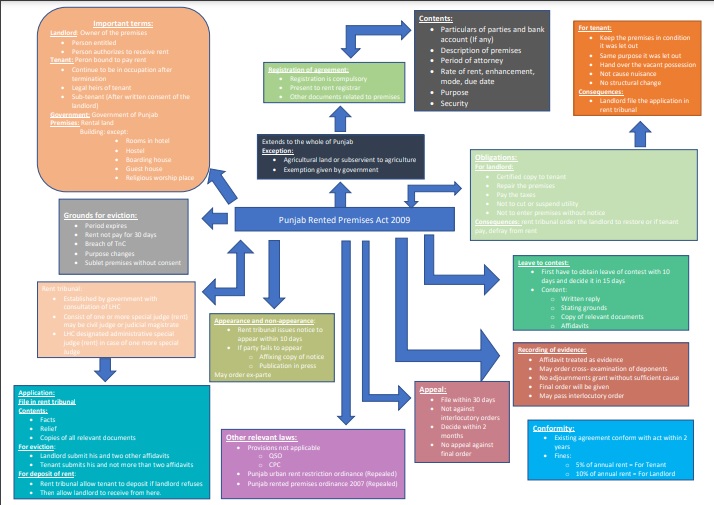
While superceding the Punjab Rented Premises Ordinance, 2007, the Punjab Rented Premises Act, 2009 (the “Act”) ultimately substituted the old Punjab Urban Rent Restriction Ordinance, 1959 aiming to regulate the relationship of landlord and tenant in respect of rented premises in a better way. It is applicable to the urban areas within the territory of the Punjab, excluding any land exempted by the government.
The Act is substantive as well as procedural. Plain reading of the Act reveals that it endeavors to ensure maximum certainty apropos matters of tenancy. It lays down the rights and obligations of tenant and landlord; similarly it provides a procedure for the protection of these rights. The owner of premises and a person who is entitled or authorized to receive the rent is defined as landlord. Whereas, the Act declares any person who is bound to pay rent including person in occupation after termination of tenancy agreement, legal heirs, and subtenant (with consent) as tenant.
In order to reduce the ambiguity regarding the relationship of tenant and landlord, the act declares registration of tenancy agreement before the Rent Registrar mandatory along the regular registration irrespective of its tenure. Otherwise, if a landlord desires to approach Rent Tribunal, he will have to deposit an amount equivalent to ten percent of the value of annual rent as penalty and in case of tenant, five percent as same penalty.
The Act has also provided the essential contents of tenancy agreement i.e. particulars of landlord and tenant, their bank accounts (if any), description of premises, period of tenancy, rate of rent, rate of enhancement (if any), mode of payment, due date, purpose of use and amount of security etc.
The Act has imposed certain statutory obligations on the landlord i.e. to provide a certified copy of the agreement to tenant, repair the rented premises and pay taxes. Besides, under the Act, it is also obligatory for the tenant not to change the structure, not to cause nuisance, handover vacant possession upon termination of an agreement, allow landlord to enter in the rented premises, use rented premises for the mentioned purpose and keep it in the condition in which it was let out.
The Act also declares grounds for the eviction i.e. expiration of tenancy period, rent is unpaid for thirty days, breach of any term or condition of agreement, use of premises for unmentioned purpose or subletting the rented premises without consent of the landlord.
Moreover, to resolve disputes between landlord and tenant, Rent Tribunals have been established in every district by Punjab Government which are presided over by the Special Judges (Rent), who are appointed with the consultation of Lahore High Court and those Tribunals shall exercise exclusive jurisdiction over cases under the Act. In order to make the proceedings under the Act expedited, provisions of Qanun-e-Shahadat Order 1984 and Code of Civil Procedure, 1908 are also not applicable.
In order to defend the application, the respondent has to file an application for leave to contest within ten days, which shall be decided within fifteen days of its filing. The Rent Tribunal may pass ex-parte order in case of non-appearance of the party and against that ex-parte order, an application may be filed within ten days. The Rent Tribunal has to pass a final order on an application within four months and the aggrieved party may file an appeal against final order within thirty days, and if filed, the appeal shall be decided within two months.

 Ahsan Legal Services
4 replies on “Extract of Punjab Rented Premises Act, 2009”
Ma shaa Allah.
Good work.
LikeLike
[…] The Punjab Rented Premises Act of 2009 is a significant piece of legislation enacted in the state of Punjab, India, with the aim of regulating the relationship between landlords and tenants in rented properties. This act provides a legal framework that governs various aspects of renting, including the rights and responsibilities of both landlords and tenants, eviction procedures, and rent control measures. Let’s delve into the key features and provisions of this important law:https://alspk.org/2022/08/24/extract-of-punjab-rented-premises-act-2009/ […]
LikeLike
How much rent increase yearly and after 3 years what Punjab law says
LikeLike
Dear sir, rate of rent to be increased as per the rent agreement. Parties may decide about the time and quantum of rent to be increased. If no such matter is written in the agreement, it will remain the same.
LikeLike