
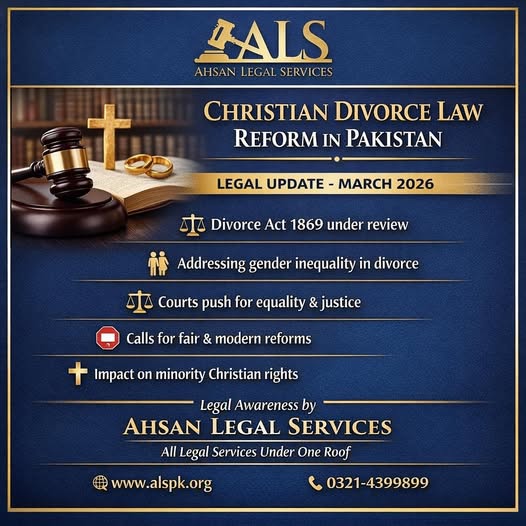
A recent court decision in Pakistan has reopened discussion about reforming the Christian divorce law, particularly the Divorce Act 1869, which dates back to the colonial era.
For more than 150 years, this law governed divorce for Christians in Pakistan and was often criticized for unequal and outdated provisions, especially affecting women.
⸻
 Key Legal Points
 Historic Law Under Scrutiny
The Divorce Act 1869 has remained largely unchanged since British colonial rule.
 Gender Inequality Issue
Previously, Christian women often had to prove adultery plus additional grounds (such as cruelty or desertion) to obtain divorce, making it more difficult than for men.
 Judicial Intervention
Courts have recently emphasized that personal laws must align with constitutional guarantees of equality and justice.
 Possible Legal Reform
The recent judgment may open the door for legislative reform, allowing Christian couples to seek divorce on fair and equal grounds.
 Impact on Minority Rights
The decision is seen as an important step toward strengthening family rights of Christian citizens in Pakistan.
⸻
 Legal Awareness
Christian family disputes such as divorce, maintenance, child custody, and property matters are generally heard in Family Courts under the Family Courts Act 1964, while applying relevant personal law.

 Ahsan Legal Services